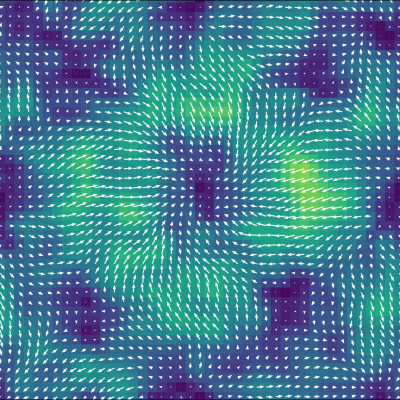
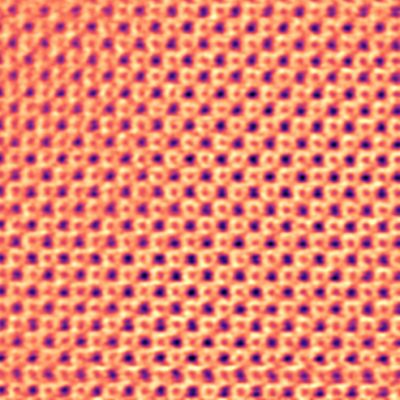
90° rotation symmetry STEM (left) and zoomed-in electric field map of [100] SrTiO3, acquired at 49,000 fps (right).
Courtesy of Paul Voyles, University of Wisconsin.
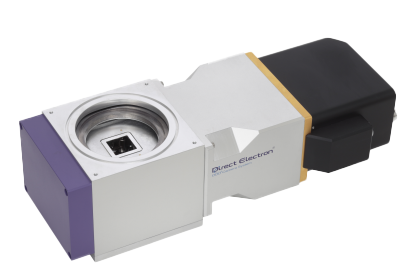
Celeritas and Celeritas XS are revolutionary new direct detection cameras for four-dimensional scanning transmission electron microscopy (4D STEM). Based on a next-generation direct detection sensor, these detectors far exceed the frame rate of other 4D STEM detectors while also delivering at least four times more pixels and exceptional image quality.
4D STEM is a cutting-edge technique that uses the richness of information available in STEM for exploring the structure of materials. Rather than a single averaged signal, 4D STEM cameras capture the full electron diffraction pattern so that researchers can peer into the subtle details of data, visualizing atoms that are difficult to see in conventional STEM and extracting information about crystal orientation, strain, electric and magnetic fields, and other important features.
However, until now researchers have had limited choices for 4D STEM detectors. Previous generation 4D STEM detectors took about 15-20 minutes to capture a one-megapixel STEM image, which is far too slow to be practical.
Celeritas is the Latin word for speed, and we could not think of a better word to describe these cameras.
The base model Celeritas features acquisition speeds of up to 16,000 frames per second, whilst the premium Celeritas XS detector features acquisitions speeds of up to 87,000 frames per second. At almost 100x faster, than earlier 4D STEM detectors, this enables a one-megapixel 4D STEM virtual image to be captured in about 12 seconds. This introduces a paradigm-shift for 4D STEM, enabling users, for the first time, to capture 4D STEM datasets at comparable speeds to conventional STEM images. 4D STEM experiments that would require hours of data collection with another detector can be performed in minutes using Celeritas or Celeritas XS.
A unique high dynamic range (HDR) imaging mode under development offers over 10x higher dynamic range per frame than was achievable in previous monolithic active pixel sensor direct detectors. Fast frame rates and a large number of pixels also facilitate greater dynamic range and enable higher probe currents to be used to acquire data, giving Celeritas and Celeritas XS the flexibility to operate over an extremely wide range of imaging conditions.
With one million (1024 x 1024) pixels, Celeritas and Celeritas XS are also excellent high-speed TEM cameras, enabling applications such as ultra-fast, sub-millisecond time-resolution for in situ TEM imaging.
The advances in both the range of imaging conditions and data throughput offered by our Celeritas and Celeritas XS detectors promise to profoundly increase the productivity of TEM facilities and accelerate discovery in materials science.
To learn more about 4D STEM, see our article in Microscopy and Analysis magazine, written in collaboration with Prof. Voyles of the University of Wisconsin Madison.
To see results from the Celeritas XS detector, scroll to the bottom of the page to find a selection of links to publications, or browse our Literature Library.
The Celeritas XS camera, with a frame rate of almost 2270 frames per second, offers the opportunity to record in situ TEM movies with a 1024 x 1024 pixel image size on time scales of less than 500 microseconds, potentially allowing for the observation of dynamic phenomena that cannot be observed by slower cameras.
The Celeritas XS camera is a uniquely versatile, ultrafast camera for 4D STEM, with a readout speed of 2,270 fps at full frame size, and up to 98,000 fps with a reduced readout area. The ability to vary the readout area is critical, as it allows the user flexibility to choose between 4D STEM techniques that require greater sampling in real space (full frame size), and those that require greater sampling in reciprocal space (reduced readout area at ultrafast speeds).
In situ 4D STEM requires a camera capable of extremely fast imaging speeds such that it is capable of recording tens of thousands of diffraction patterns per second, in order to facilitate a practical temporal resolution for STEM imaging. With minimum dwell time of 10.2 microseconds per diffraction pattern, the Celeritas XS allows a 4D STEM dataset of 256 x 256 scan points to be recorded in as little as 0.67 seconds. The high speed of Celeritas XS allows dynamic changes in the structure of specimens to be recorded on meaningful time scales.
If you have further questions about our products, head to our FAQ page, or contact us to learn more.
Celeritas is ready to order now.
Looking for something else? We offer a full range of products for electron microscopy:
Apollo | DE Cameras | LV-16 | SEMCam | DE Freescan | Software
Dive deeper with a carefully curated list of journal articles! Search by Application, Technique, Impact and more!