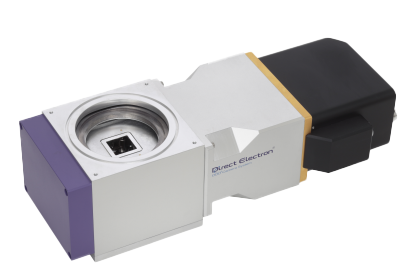
The DE-16 features the 10th generation of our revolutionary Direct Detection Device (DDD®) sensor, delivering industry-leading resolution and flexible, seamless viewing on a 4k x 4k field-of-view. The DE-16 has 6.5 μm pixels optimized for superior resolution (MTF) over a broad range of magnifications and exposure rates. The DE-16 is our most versatile direct detection TEM camera, featuring continuous 4k x 4k pixel streaming at up to 92 frames per second, enabling TEM experiments that were not previously possible on a direct detector.
This flexibility, along with the latest sensor technology allows for industry-leading resolution for use in materials science or biology. The DE-16 offers versatility that no other camera can match, and can be used for numerous applications on the same instrument, including in situ, 4D STEM, Cryo-EM, micro electron diffraction, holography, ultrafast TEM, and EELS. Along with an integrated Faraday plate, users can access full-frame streaming at up to 92 frames per second or select smaller areas to readout at substantially faster frame rates (128 x 128 @ 4,237 fps).
We offer two alternative sensor upgrades for the DE-16 that can enhance the versatility of the detector even further:
Note that these sensor upgrades can either be purchased with a new DE-16 detector, or can be installed on an existing DE-16 detector in the field.
The DE-16 camera has the versatility to support a diverse mixture of different users and applications. Some electron microscopy facilities require one camera to support a wide range of different techniques for different users, from Cryo-EM to 4D STEM. With its wide array of different configurations, the DE-16 is adaptable for any of these techniques.
Direct Electron’s Celeritas XS, Apollo, and DE-16 detectors are compatible with in-column Omega filters, and the post-column CEFID energy filter from CEOS, which can be installed on a wide variety of models of electron microscopes. Energy filtered TEM is important for reducing blurring effects caused by inelastically scattered electrons, which can help to improve image resolution, particularly for thicker specimens, and EFTEM can also be used for elemental analysis.
The Celeritas XS and DE-16 detectors can both be used for EELS when installed with a CEFID energy filter from CEOS. Direct electron detectors are an excellent choice for EELS, and their high sensitivity makes them particularly suited to detecting core-loss edges at low beam currents.
If you have further questions about our products, head to our FAQ page, or contact us to learn more.