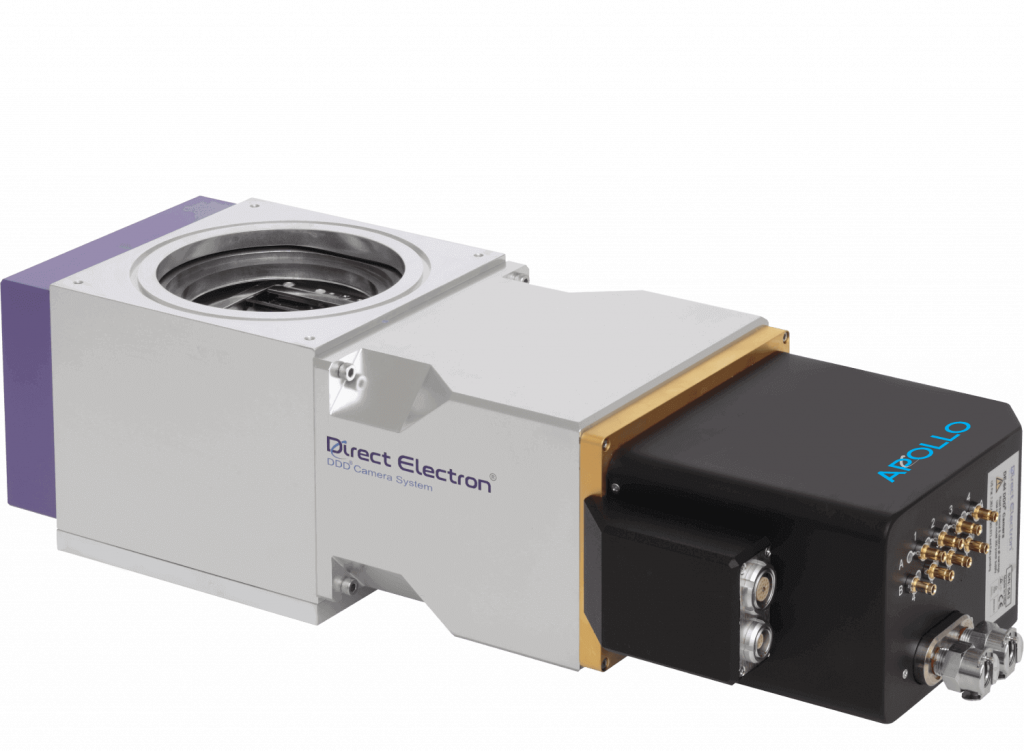
APOLLO CAMERA ADAPTED FOR BEAM SENSITIVE MATERIALS SCIENCE SAMPLES
Artemis is a dedicated counting direct detector for HR-TEM imaging, liquid in-situ TEM movies and 4D-STEM
Artemis is based on the counting-only Apollo direct detector. Artemis delivers ultra-low noise imaging and diffraction data for beam-sensitve materials science applications. The dedicated electron counting is performed in hardware, making it elegant, fast, easy-to-use, and enables low-dose in-situ movies with counted electrons. This means the same dose gives ~2.5x more signal and contrast than linear/integrating mode cameras.
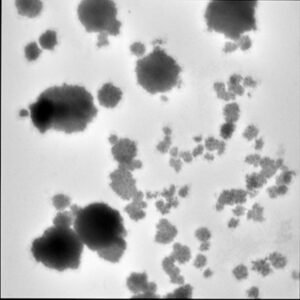
Snapshot of platinum nanoparticle formation during in-situ electrochemistry.
Courtesy of Maria de Marco, IPCMS Strasbourg.
4k × 4k (16.8 million) physical pixels with larger 8 µm pixel size provides high-resolution imaging over a large area so that no action is missed. Counted movies saved to the computer at 120 fps for 4k x 4k frames, or 240 fps for a 2k x 2k ROI. Artemis is integrated with Protochips for holder metadata, and can be integrated with other holders on request.
Switching liquid phase in-situ experiments to Artemis gives researchers quantitative measurements of the dose on their sample, and furthermore allows them to lower the dose to reduce radiolysis while maintaining high signal and contrast in the movie frames. Counting electrons are simply recorded more efficiently and with higher resolution than on traditional integrating/linear mode direct detectors used as in-situ cameras. Furthermore, Artemis is many times better in terms of efficiency and resolution than using a CCD, scientific CMOS or scintillator-coupled camera for in-situ movies.
In-Situ movies on Artemis are recorded using the Mission Control “Operando” package. This allows features such are timelapses, adjusting movie time resolution, and “lookback/timewarp” feature to begin saving data from a few seconds before you click “start saving”.
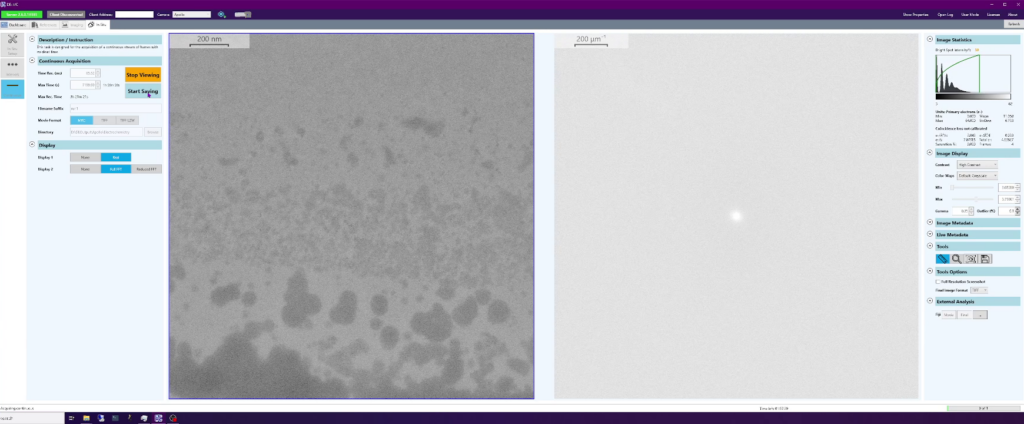
Mission Control: in-situ electrochemistry movie acquisition with Artemis at 15 fps and 0.4 e/Å2/s corresponding to 47 e/pix/s
All of the above-mentioned advantages also translate to high quality single images of beam-sensitive samples. The live drift-correction in Mission Control combined with the lack of noise allows users to acquire a single image over many seconds, resulting in a crisp, high contrast single image of the sample. If there is lattice or atomic resolution present, users can click on each FFT spot to view the lattice spacing directly.
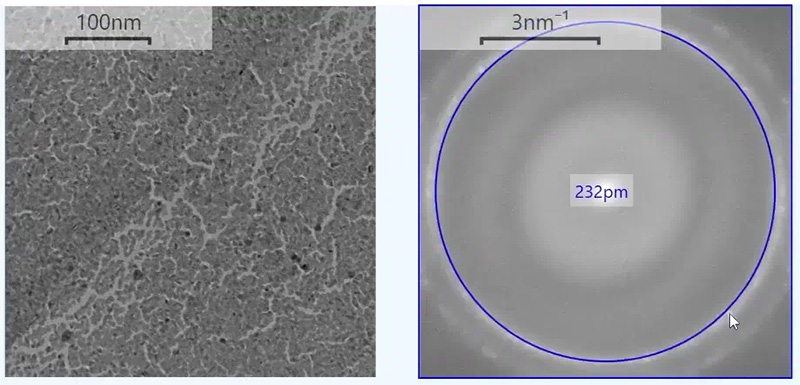
Mission Control: in-situ electrochemistry movie acquisition with Artemis at 15 fps and 0.4 e/Å2/s corresponding to 47 e/pix/s
Artemis can operate in event-streaming format to record counted low-dose 4D-STEM data for strain and orientation mapping on beam sensitive samples. This operates by recording data in sparse mode over a huge sensor area, but binning the data down to record patterns with a normal dynamic range and high signal in each diffraction disk. For example recording sparse counted data at a 2k x 2k ROI, but binning the output to a 256 x 256 pattern, Artemis runs at 5,120 fps. In general this speed can be doubled by halving the rows in the ROI. So a 128 x 128 4D-STEM pattern would be acquired at over 10,000 fps.
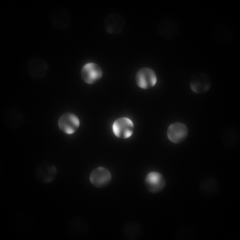
While this is not as fast as our Celeritas XS detector, it enables 4D-STEM to be performed on the same camera as low-dose imaging experiments.
Similar to Apollo, Artemis also functions as an outstanding cryo-EM camera for collecting single particle data. Mixed-use facilities can take advantage of Artemis’ flexibility to provide techniques for materials scientists and structural biologists with the same detector and microscope. Data collection is automated through Serial EM for advanced users, or SmartScope for general users.
Single particle data collection through SmartScop link : https://docs.smartscope.org/usage/preparation/serialem/
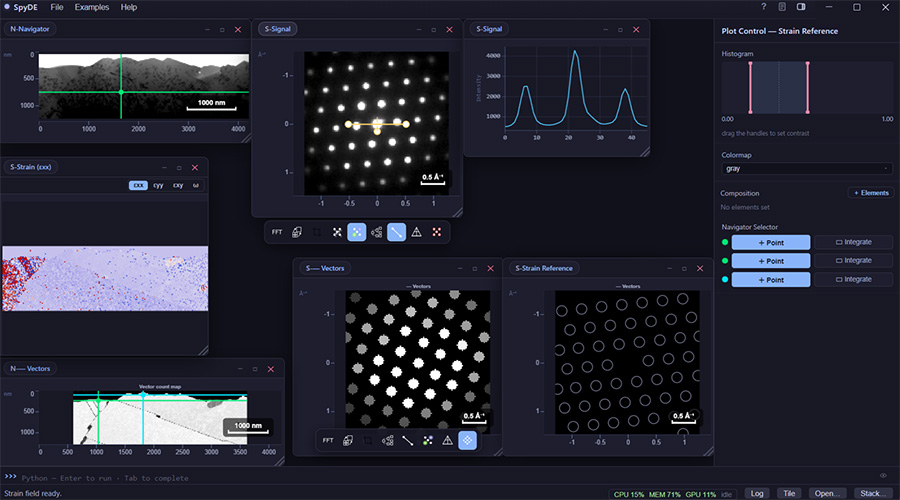
SpyDE is an open-source GUI development by direct electron, running Hyperspy and Pyxem functions under the hood. It provides lazy-loading/virtual stack loading of movies and 4D-STEM data so than even datasets of 100’s of gigabytes can be analyzed and the results easily exported for presentation. For in-situ movies that means timestamps, scalebars and stimuli being added. For 4D-STEM that means GUI-based strain mapping and orientation/phase mapping.
Apollo is ready to order now.
Looking for something else? We offer a full range of products for electron microscopy:
Apollo | Celeritas | DE Cameras | LV-16 | SEMCam | DE Freescan | Software
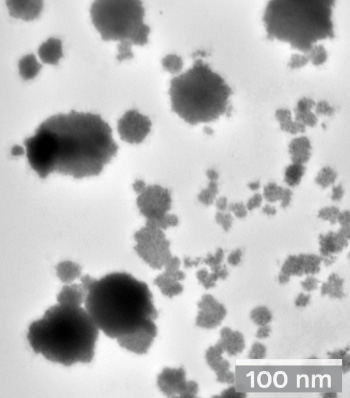
Platinum nanoparticle formation during in-situ electrochemistry acquired with Artemis.
Dive deeper with a carefully curated list of journal articles! Search by Application, Technique, Impact and more!