
THROUGHPUT MATTERS
In single-particle cryo-EM, more good particle images generally mean higher resolution and a better chance of resolving small features. But microscope time is limited and expensive. A second saved on each exposure adds up to thousands of extra movies over a session, so acquisition speed is one of the most practical ways to get more out of an instrument. Apollo is built for this: a fast, low-noise sensor that keeps up with rapid acquisition without giving up the image quality that high-resolution work depends on.
Hybrid detectors use large pixels (55-150 µm) to try to stop electrons fully in the sensitive layer. This limits the number of pixels that can fit on a sensor. So, hybrid detectors are typically limited to a maximum of 256 x 256 pixels. Any hybrid detectors larger than this are typically squeezing 4 smaller sensors alongside one another, resulting in a cross-shaped dead area on the camera.
MAPS detectors use small pixels (5-15 µm) that let electrons pass through them. They typically have 1024 x 1024 pixels or more with no dead area. This is an important consideration if you want to use the camera for TEM diffraction, Micro-ED, TEM imaging or if you anticipate your 4D-STEM pattern having many small spots that need to be identified for strain mapping. Having many pixels is also advantageous for performing precise pattern-shift corrections.
Table 1: Imaging conditions for the high-throughput apoferritin dataset.
| Parameter | Value |
|---|---|
|
Microscope |
JEOL CRYO ARM 300 II |
|
Accelerating voltage |
300 kV |
|
Spherical aberration (Cs) |
2.7 mm |
|
Spot size / angle |
2 / 1 (Köhler illumination) |
|
Detector |
DE Apollo |
|
Magnification |
150,000× |
|
Pixel size |
0.572 Å/pixel |
|
Total electron dose |
~30 e⁻/Ų |
|
Frames per movie |
29 |
|
Exposure time |
0.47 s |
|
Defocus range |
0.5 to 1.0 µm |
|
Image-shift pattern |
7×7×7 (10 µm radius) |
|
Acquisition time per movie |
1.7 s |
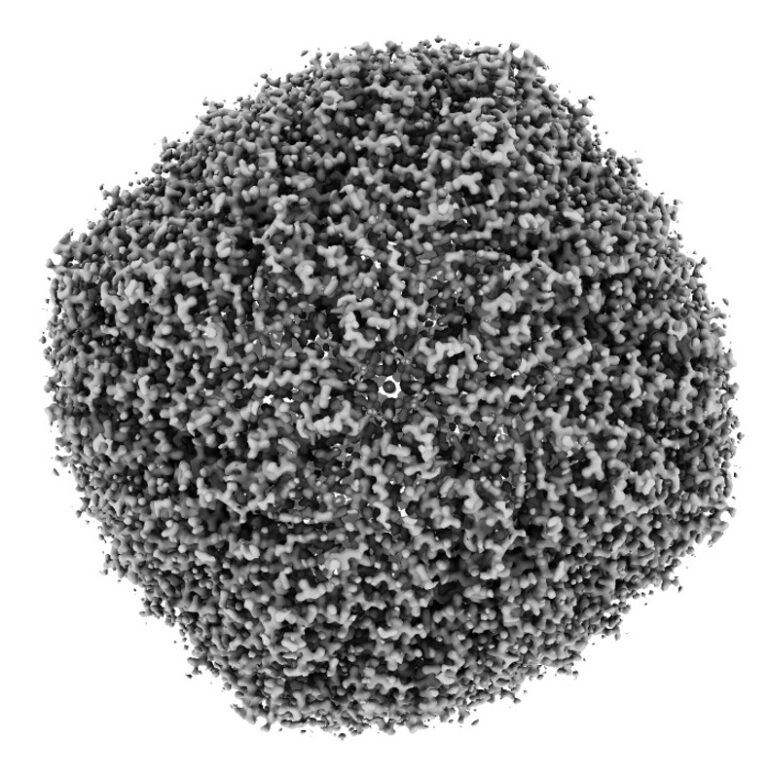
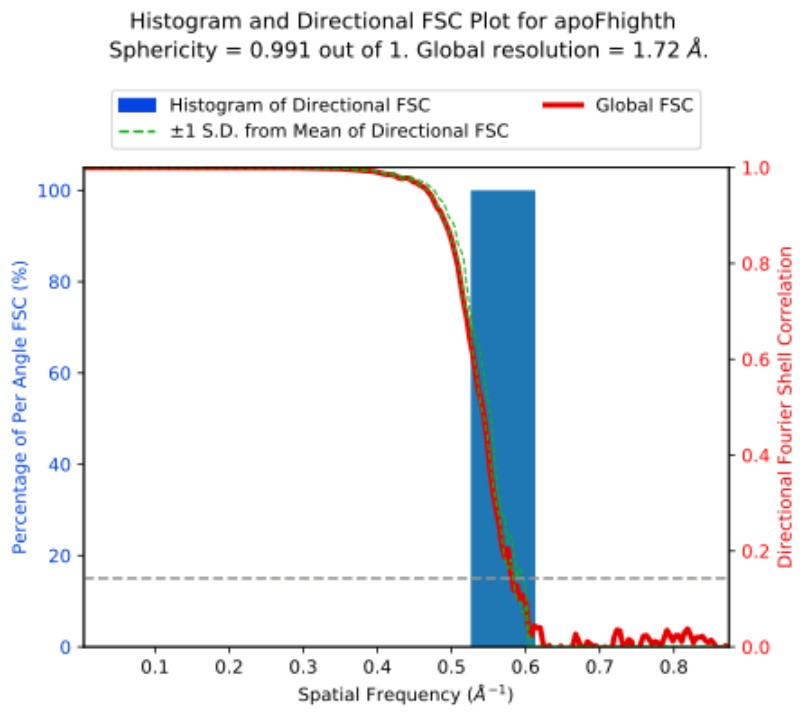
Apollo recorded 1,820 movies per hour, or about 1.7 seconds of acquisition per movie. In roughly 3.5 hours the run produced 6,209 movies and 502,311 particle images, which reconstructed to 1.72 Å in RELION-4.
Driven through the Virtual TEM Controller, Apollo sustained 1,820 movies per hour and reconstructed apoferritin to 1.72 Å from a single 3.5-hour session, collecting more than half a million particles in an afternoon.
Figure 1: Apoferritin reconstructed at 1.72 Å from 502,311 particles collected on Apollo in about 3.5 hours, with the corresponding 3D-FSC (Fourier shell correlation) plot showing directional resolution.
HOW WAS THE SPEED ACHIEVED?
The slowest part of high-throughput collection is usually moving from one target to the next. Driving the stage to each hole is slow, because the stage has to settle before the image is stable. Image shift (also called AFIS, for aberration-free image shift) avoids this by deflecting the beam electronically to nearby targets instead of moving the stage.
How the image shift is driven makes a large difference. The team compared three ways of collecting at a fixed 0.425 s exposure (60 fps, 26 frames):
| Acquisition method | Recording speed | Throughput |
|---|---|---|
|
No image shift (stage only) |
1.23 s/movie |
2,904 movies/hour |
|
Image shift via Low Dose Mode (LDM) |
2.10 s/movie |
1,714 movies/hour |
|
Image shift via Virtual TEM Controller (VTC) |
1.67 s/movie |
2,154 movies/hour |
CAN IT GO FASTER?
Increasing dose rate on Apollo runs into limitations for dose fractionation – >2 e-/Å2 in the first frame severly limits high resolution signal. Increasing the frame transfer rate to 120fps could be one method to improve throughput for very high resolution experiments.
A wider image-shift range: Increasing the image-shift range past 17 µm is enough to fit an 11×11×3 multi-shot pattern on R1.2/1.3 grids, projecting to about 1,800 movies per hour at 60-80kX
CONCLUSION:
Apollo already collects at benchmark speed today: up to 2,904 movies per hour, and a sustained 1,820 movies per hour across a full run that fed half a million particles into a 1.72 Å apoferritin map in a single afternoon. Apollo’s high dose-rate capability and wide image-shift range leave room to push throughput further still. Where microscope hours are the limiting factor, Apollo is a straightforward way to collect more particles and solve more structures per session.
Processing in RELION-4. Direct Electron gratefully acknowledges Prof. Kato, Bartosz Marzec, and Fumiaki Makino for their collaborative work.
Source: Data presented at cryoDuck Tokyo Days 2026, Japan.
Affiliations: Prof. Kato, Osaka University, Osaka, Japan. Bartosz Marzec, JEOL Europe. Fumiaki Makino: ¹JEOL Ltd., Akishima, Tokyo, Japan; ²Graduate School of Frontier Biosciences, The University of Osaka, Suita, Osaka, Japan; ³JEOL YOKOGUSHI Research Alliance Laboratories, The University of Osaka, Suita, Osaka, Japan.
