
Microelectron diffraction (MicroED) has become a powerful tool for determining the atomic structure of microscale and nanoscale crystals, particularly in the pharmaceutical industry where structural precision is critical. Its ability to work with extremely small crystals makes it an attractive alternative to traditional X-ray crystallography.
In a recent study, researchers explored the use of the Apollo direct electron detector for MicroED. Thanks to Apollo’s high frame rate and extremely low coincidence loss, accurate atomic structures were generated from single-crystal datasets acquired in as little as 50 seconds, using a total electron dose as low as 0.5 e⁻ Å⁻². These results highlight the potential of fast, low-dose MicroED data collection to accelerate structural analysis workflows while preserving sample integrity—key advantages in fields like drug discovery and materials science.
Fast event-based electron counting for small-molecule structure determination by MicroED,
N. Vlahakis et al. Acta Cryst. C81, 116–130 (2025)
Read the abstract here: https://chemrxiv.org/engage/chemrxiv/article-details/66db946ecec5d6c1425cd490
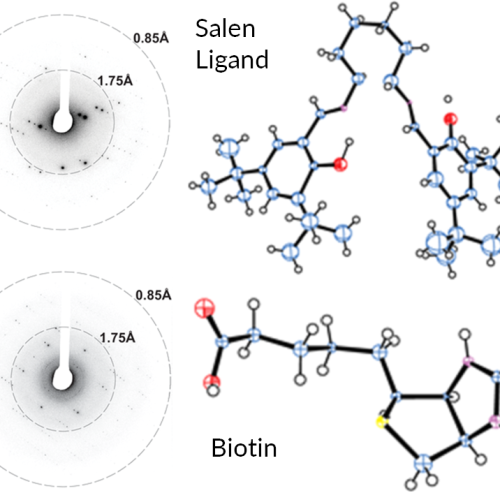
Diffraction patterns recorded by Apollo and atomic structures calculated from Apollo data for Salen Ligand and Biotin.
Images from paper adapted under license CC BY 4.0
