New 100kV direct detector for Cryo-EM
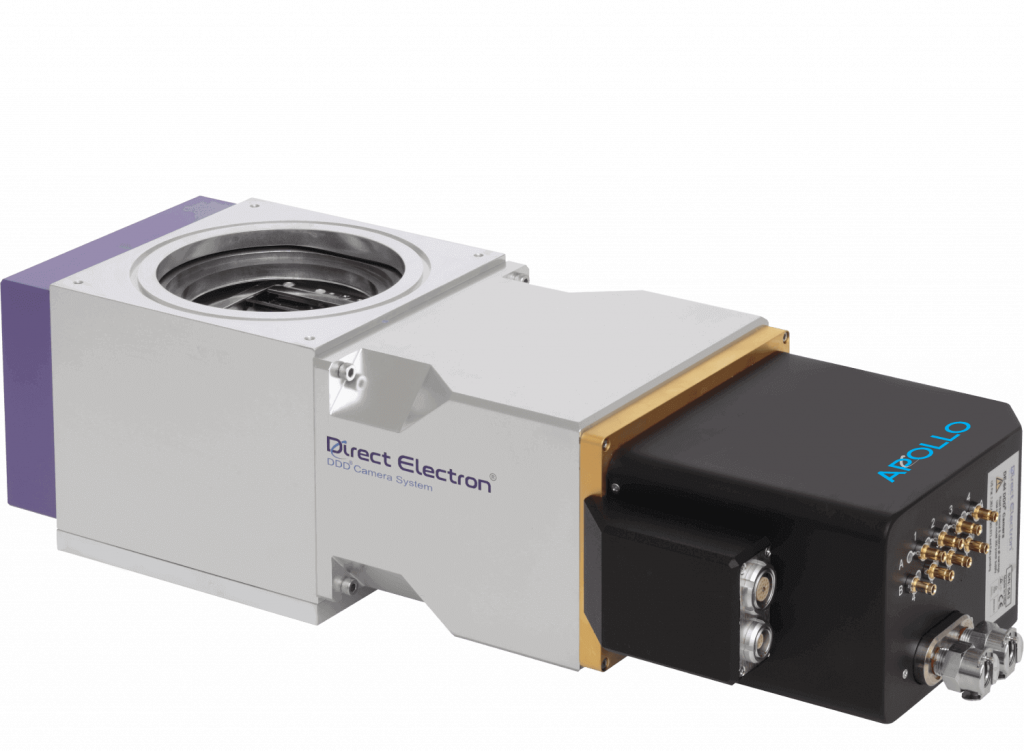
Centuri is a dedicated counting camera built to maximize the quality of cryo-EM data at 100keV. Based on the Apollo camera, Centuri features an optimized low-kV sensor to maximize quantum efficiency at lower keV. In this process, the sensitive “epi” layer of the sensor was moved closer to the surface, and the whole sensor was made super-thin to reduce backscattering and the associated false-positives.
The result is that Centuri has all the power of the proven Apollo camera, with next-generation counting allowing an internal framerate of 2560 fps, streaming dose-fractionated frames at 60 fps to disk for motion correction. This speed is delivered on a 4096 x 4096 pixel sensor, with 8µm pixels. Combined with the low-kV optimization, Centuri allows 100kV cryo-EM to become a truly valid platform for rapid protein imaging with high contrast. This high contrast can be applied to high-resolution imaging of small molecules, or for rapid sample screening on less costly 100kV instruments.
The first Centuri camera was installed in spring 2026 at the Stanford-SLAC cryo-EM center. It was mounted on a TFS Tundra, underneath the Falcon-C detector that comes with the microscope.
To evaluate the performance of Centuri, single particle analysis apoferritin data was collected through Serial EM. Data was collected first on the Falcon-C, then a few days later on Centuri, from the same grid. The resulting reconstructions are shown below.
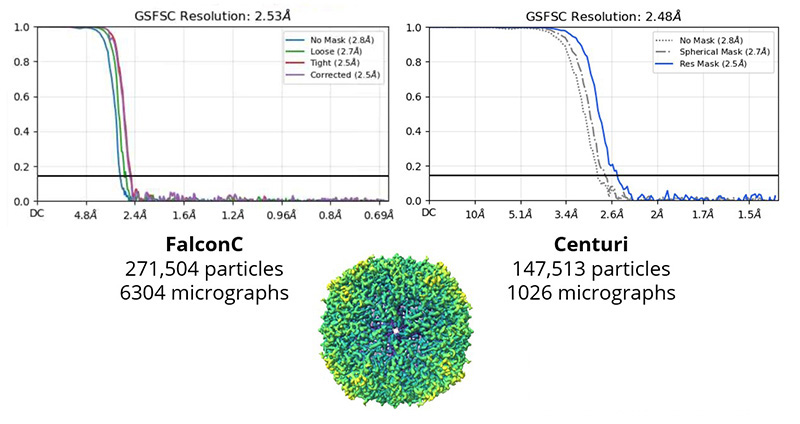
Despite the data being acquired on an older sample, particles imaged on Centuri reconstructed to a slightly higher resolution, 2.48Å versus 2.53Å. Crucially this structure used fewer particles and much fewer micrographs than were required for the Facon-C structure.
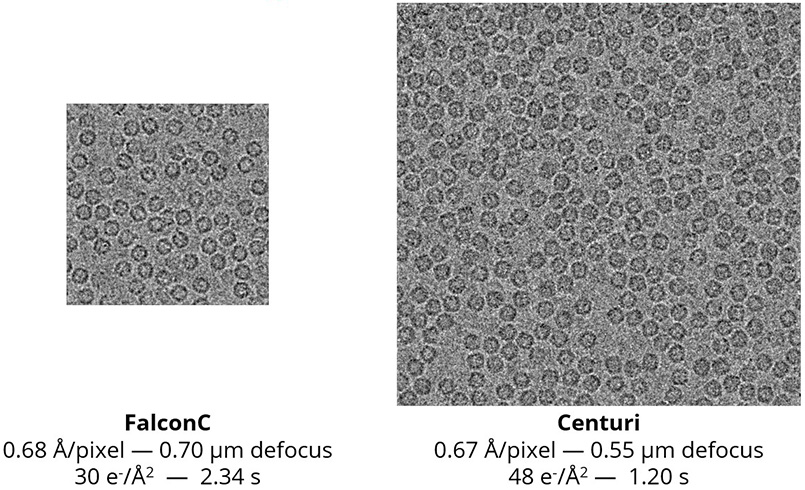
Looking at examples of the raw data, the reason is clear; despite using almost the same pixel size, Centuri is a 4k x 4k detector while the Falcon-C is a 2k x 2k detector. Each image from Centuri contains 4 times the number of particles. Combined with the faster counting speed of Centuri, and thus the lower exposure time, there is a powerful impact on the data acquisition throughput.
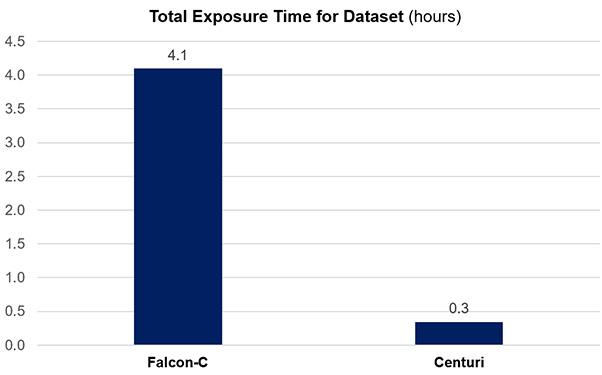
By increasing the dose rate, users can leverage Centuri’s fast electron counting to acquire micrographs with much shorter exposures. These shorter exposures per micrograph and the larger detector area translate into a more than 10x decrease in the total exposure time necessary to collect a dataset. With 6x fewer micrographs required, the delays between each acquisition are also 6x shorter, thus allowing users to increase their cryo-EM SPA throughput by an order of magnitude.
Traditionally, the danger in increasing the beam current and the dose rate on the camera is that you would suffer increased co-incidence loss. Effectively the detector quantum efficiency (DQE) would be reduced by the camera missing electrons as the counting speed couldn’t keep up. The apoferritin structure from Centuri matching the resolution of that produced by the Falcon-C dissipates those concerns. Furthermore, the Reslog plot below illustrates quite the opposite story.
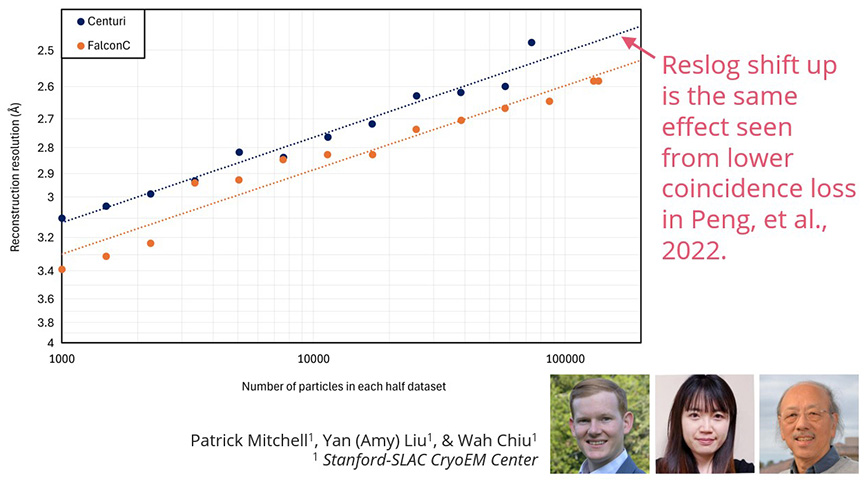
The resolution added by each additional particle is higher for Centuri than for the Falcon-C, this indicates that despite the increased dose rate, the Centuri data has less coincidence loss than the Falcon-C data. Thus, the researchers could have increased the dose rate even further, if aiming for the highest throughput.
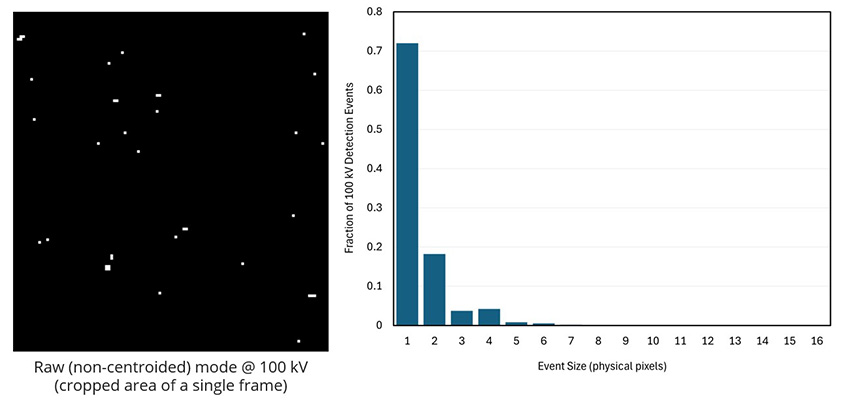
The final ingredient in making Centuri an exceptional camera for 100keV Cryo-EM is shown above; the event size is very small even before the electron counting algorithm is applied. The event size measures how many pixels each incoming electron deposits its charge into. The small event size makes the counting algorithm very accurate at localizing the point of impact on the detector, and means that there is more space for electrons to arrive. This results in high frequency information being faithfully recorded, i.e. a very good MTF (modulation transfer function), which is the main contributor to the DQE near the Nyquist frequency. Thus Centuri achieves a high DQE, at a wide range of beam currents, to produce outstanding images at 100keV.
Centuri is ready to order now.
Looking for something else? We offer a full range of products for electron microscopy:
Apollo |Celeritas | DE Cameras | LV-16 | Meridian | DE Freescan | Software
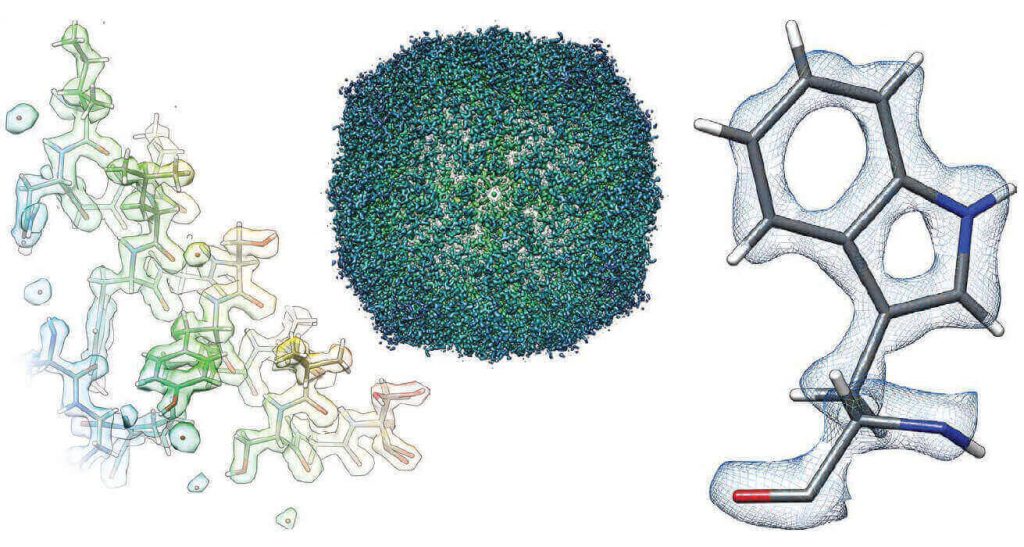
1.46 Å resolution cryo-EM structure of apoferritin (EMD-33707) from Apollo on a JEOL CRYO ARM 300 II, acquired at 12 e-/physical pixel/s (eps).
Dive deeper with a carefully curated list of journal articles! Search by Application, Technique, Impact and more!