
Zenith is an EBSD detector built to produce patterns at high speed, but without sacrificing quality. It typically operates in Bin 2x mode, running at 5,500 pps for a 512 x 512 pixel pattern. Since it is a direct detector, the pattern quality is higher for a given beam current than traditional scintillator detectors. Zenith contains a multi-gain option within each pixel, meaning it can run with a huge dynamic range, accepting 100’s of nA beam current on the sample at 5-30keV. It is very efficient at both traditional EBSD voltages and low voltages, producing high-quality patterns across the whole range of 5-30kV, and even lower too.
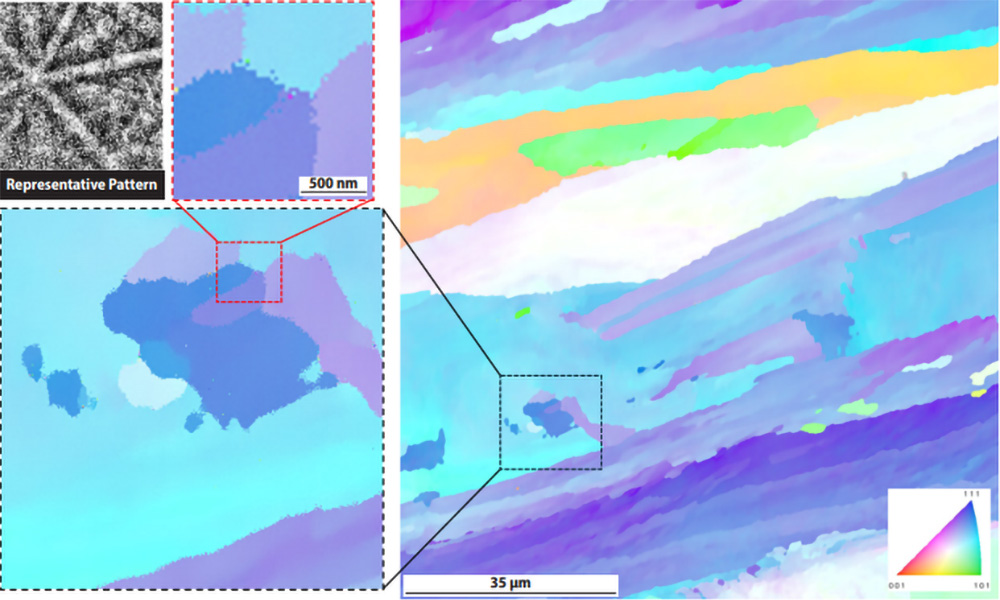
Additively Manufactured CoNi Superalloy — Solidification cells in melt pools.
100um HWF, 2000 x 2000 points, 50nm step, 10kV, 5850 pps, 11 min scan.
Alternatively, the multi-gain mode means that Zenith can run with enhanced sensitivity, to collect the highest quality patterns of challenging samples, or for HR-EBSD analysis. For HR-EBSD, the sensor is operated in Bin1, giving 1024 x 1024 pixel patterns at 2,200 fps. Typically many frames will be integrated for HR-EBSD, resulting in longer dwell times per pattern to achieve the desired resolution/sharpness of the smallest band-edge features.
Leveraging the high signal-to-noise ratio for single electrons, Zenith can measure the energy of each electron in an EBSD pattern, to perform live energy-filtered EBSD, or to measure the energy spectrum of the scattered electrons from different regions of the pattern, or different parts of the sample. This can be directly related to the scattering history and penetration depth of the electrons from that area.
Finally Zenith can be position flat, in a transmission geometry, to enable TKD or 4D-STEM in the SEM. For TKD, full-frame is typically used. For 4D-STEM in the SEM, Zenith’s small 15um pixel size is very useful for resolving diffraction spots when there is no projection lens to add camera length. Users can readout a reduced central ROI to increase the dynamic range and speed of the camera to e.g. 56,000 fps for a 128 x 128 pixel pattern. This makes 4D-STEM in the SEM incredibly fast.
EBSD scans are acquired through our ‘Mission Control’ software. This provides live virtual images, similar to ECCI or backscattered images, during acquisition. It will soon provide live indexing for real-time orientation maps, and live pattern-sharpness evaluation for real-time dislocation density maps.
Zenith can save data in .mrc, .up2, or .h5EBSD formats. This facilitates re-indexing in existing commercially available software, or open-source software packages such as EMSoft for dictionary indexing. For strain mapping, Zenith is integrated with CrossCourt software from BLGVantage.
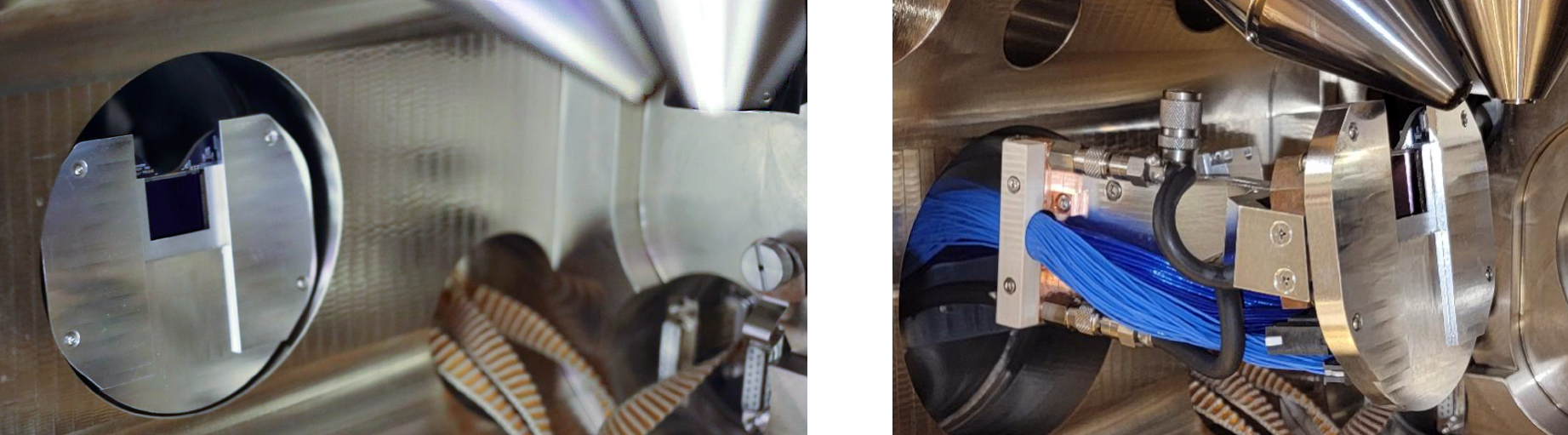
Zenith is design to mount to a 100mm EBSD port, which is standard for TFS SEMs and FIB-SEMs. The heart-shaped camera head allows Zenith to fit underneath a FIB column to achieve an excellent collection angle. Typical detector distance is 15mm. Zenith retracts fully into the EBSD port to allow normal microscope operation while not collecting EBSD scans.
Zenith is ready to order now.
Looking for something else? We offer a full range of products for electron microscopy:
Apollo | Celeritas | DE Cameras | LV-16 | DE Freescan | Software
If you have questions about our products, head to our FAQ page, or contact us to learn more.
