
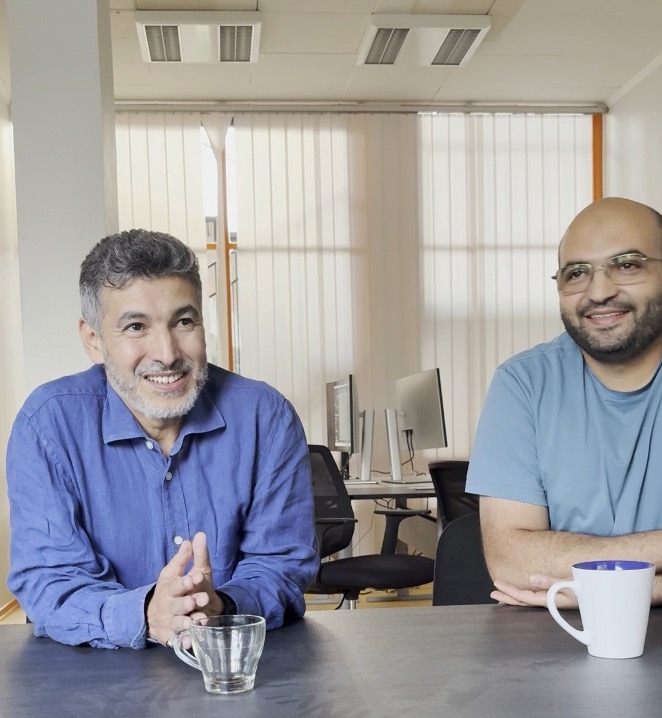
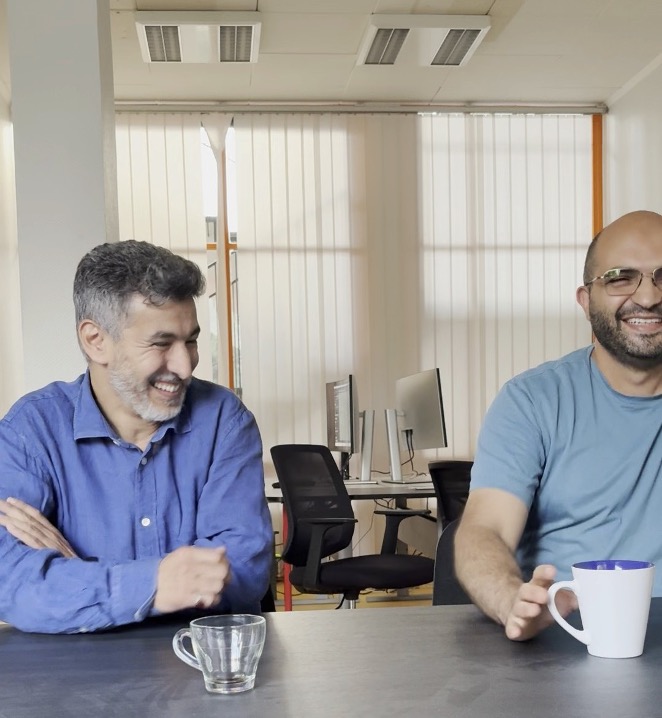
Dris Ihiawakrim (left) and Mounib Bahri at IPCMS, Strasbourg, pondering what colour electrons should be.
Most of what passes through a transmission electron microscope has stopped moving. Dris Ihiawakrim would like to change that.
For close to two decades, Dris has been part of the furniture, in the best possible sense, at the Institut de Physique et Chimie des Matériaux de Strasbourg (IPCMS). He arrived in 2006 as a chemist in the inorganic materials department, became a CNRS research engineer in 2008 and, somewhere between running instruments and co-supervising PhD students, earned his own doctorate in 2019 with a thesis on advanced TEM of fragile materials. In 2021 the University of Strasbourg gave him its research expertise prize for developing liquid-cell TEM. Since 2022 he has been Technical Director of the IPCMS European TEM platform running a whole host of microscopes, including an image-corrected JEOL GrandARM with a CEOS energy filter and direct detectors.
Seated beside him is Mounib Bahri, who began his microscopy career with a PhD at Paris-Saclay (2016) characterising defects in III–V semiconductors grown on silicon. Four years as a postdoc at IPCMS followed, then a move to the University of Liverpool’s Albert Crewe Centre managing probe-corrected JEOL TEMs with a similar capabilities to the setup in Strasbourg. He has recently returned to IPCMS as a postdoctoral researcher with two ambitions: watching catalysts work under gas, and imaging individual organic molecules at 60 kV without destroying them.
We sat down with both of them in Strasbourg to talk about where in-situ TEM and scientific life more broadly, goes next.
This is our interview with Dris Ihiawakrim and Mounib Bahri.
— Mounib Bahri, on AI in scientific writing
This interview has been edited for brevity and clarity.
DE: Let’s start with the basics. What are your names and positions?
Dris: My name is Dris Ihiawakrim. I’m a research engineer with the CNRS, here at IPCMS.
Mounib: Mounib Bahri. I’m a postdoc here at IPCMS.
When did you do your PhDs, and what were they on?
Dris: I did my PhD in 2019, at the same time as holding my position here as an engineer. It was on cryo-microscopy of sensitive materials: finding the right conditions to be able to image very sensitive materials.
Mounib: Mine was in 2016, in Paris. It was the structural characterisation of III–V semiconductors on silicon. We used electron microscopy mainly to characterise the defects in these materials, dislocations, twin boundaries, all of these, using high-resolution TEM and STEM.
For both of you: what was the first TEM you ever touched, and the first sample you ever looked at?
Dris: My first microscope was a Topcon 002B. It’s really old. The story is that engineers from JEOL started the company, Topcon, maybe fifty years ago. They sold maybe 50 or 70 microscopes in Europe, and after that they closed. But it’s a very good TEM, a high-resolution TEM. The pole piece is really small. The resolution was 0.19 nanometres.
Dris on his first love, the now-defunct Topcon 002B. Mounib approves.
DE: And the very first sample?
Dris: Magnetic nanoparticles. I came here as a chemist. I did a lot of synthesis, and I needed to see the shape and the size. So my very first sample was iron-oxide nanoparticles.
Mounib: For me it was during my PhD. A JEOL 2200FS, probe-corrected, with an omega filter.
DE: So your first-ever microscope was a filtered, probe-corrected instrument?
Mounib: It was the first microscope I had seen. I started high, and then I went down with time. My first sample was a thin film, a III–V semiconductor on silicon. We prepared many samples ourselves, ion milling with the PIPS, polishing, then you go to the microscope. You learn how to do zone-axis orientation, then TEM, then STEM, different techniques.
Mounib’s career advice: start with the probe-corrected microscope if you can!
DE: And the very first sample?
Dris: Magnetic nanoparticles. I came here as a chemist. I did a lot of synthesis, and I needed to see the shape and the size. So my very first sample was iron-oxide nanoparticles.
Mounib: For me it was during my PhD. A JEOL 2200FS, probe-corrected, with an omega filter.
DE: So your first-ever microscope was a filtered, probe-corrected instrument?
Mounib: It was the first microscope I had seen. I started high, and then I went down with time. My first sample was a thin film, a III–V semiconductor on silicon. We prepared many samples ourselves, ion milling with the PIPS, polishing, then you go to the microscope. You learn how to do zone-axis orientation, then TEM, then STEM, different techniques.
Mounib’s career advice: start with the probe-corrected microscope if you can!
DE: That’s a lot for your first session. What is your research area now?
Dris: Now I work a lot in in-situ liquid, and also in-situ gas. The goal is to see the nucleation and growth of nanoparticles, to elucidate the processes of the synthesis.
Dris: I also have a project with bacteria, magnetotactic bacteria, which synthesise magnetic nanoparticles inside themselves. I want to know exactly how the iron goes inside, how the bacteria find the iron. We have bacteria from Brazil, grown without iron. First we put the bacteria on the chip, then in the microscope we add a solution with iron at a very, very low concentration, and we see how the bacteria take this iron, so we can follow the nucleation and growth of the nanoparticles. Their capability to do this is perfect for nanoparticles. It’s really nice.
Dris, describing bacteria eating iron inside the TEM
DE: So the bacteria stay alive in the microscope?
Dris: Yes, for around a minute under the beam. With a direct detection camera like the Apollo, we hope to keep them alive for longer.
DE: Has anyone ever imaged living things in the microscope before?
Dris: Yes, we did. But the problem is the camera. With the CCD camera it is difficult to have the contrast. When the nanoparticles are there, we see the bacteria, because the nanoparticles increase the contrast. But we are sure we can image them living in the microscope, under the beam, with a very low dose. That is how we want to work, and we are going to do it.
— Dris Ihiawakrim
DE: That’s exciting. And you, Mounib?
Mounib: I have two big projects. The first is in-situ gas applied to catalysis in general, reactions like oxygen reduction or CO₂ methanation. We try to correlate the imaging with gas-phase analysis using a residual gas analyzer, so we see the structural evolution of the particles during the reaction, during oxidation or reduction.
Mounib: The second is imaging beam-sensitive materials at low dose, like organic molecular materials. We want to take advantage of fast direct detection cameras like the Apollo and Celeritas, low dose and the image-corrected microscope to go down to the molecules.
DE: In cryo?
Mounib: No, in normal mode. With low kV, 60 kV, the image corrector and the faster direct detection cameras, you can see the molecules. That’s the challenging project we want to try.
DE: What is the favourite paper you read this year?
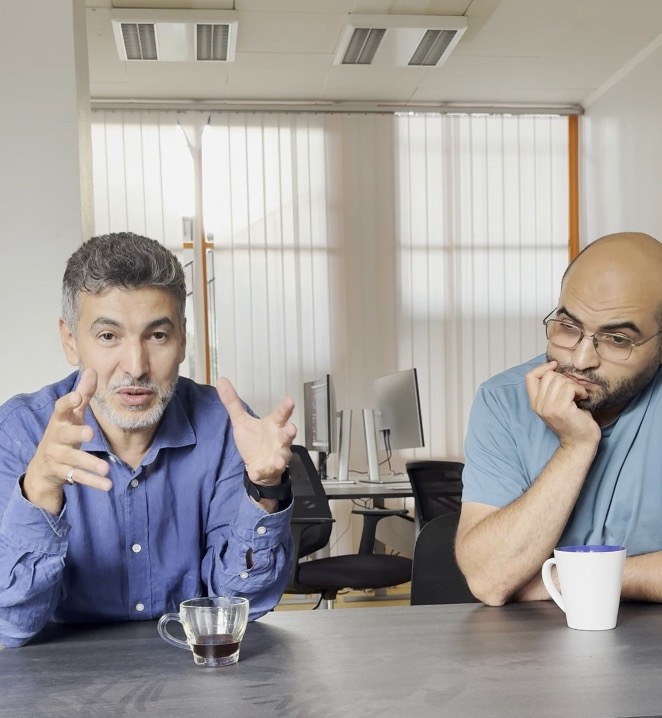
Dris: It’s a good question, because we read a lot. Maybe I will choose our own: we were the first team in the institute to do a paper in in-situ electrochemistry. It is in ACS Nano. We followed the evolution of a cobalt spinel oxide catalyst during cyclic voltammetry, and it was not totally reversible. We also saw that when it becomes amorphous the catalytic activity increases a lot, but when it is totally amorphous, the properties of the catalyst are lost.
Dris: Being at the microscope and seeing the evolution in real time was really amazing. But we used a CCD camera. With this microscope we hope to have better results, and to go to very high resolution to see what happens at the atomic sites during the transition
Seeing a catalyst change in real time: “really amazing.”
Mounib: I have two. One I found this year, from an academic group, on molecular imaging in the microscope. It’s really exciting to see this kind of capability, especially because everything they did was with older CCD cameras. Imagine if we do the same with the new direct detection cameras. That will be amazing. So we just need to go and try.
Mounib: The other paper I read and re-read is a review on MAPS detectors, explaining all of that. It helped me a lot to understand direct detection systems.
Who is your scientific crush?
Mounib: Honestly, there are two, both Nobel Prize winners. Alain Aspect, because I know him: he was one of my teachers during my master’s degree, and I was always amazed when he explained things about optics. He won the Nobel Prize in Physics a few years ago. And Omar Yaghi, one of the three winners of last year’s Nobel Prize in Chemistry. He’s one of the inventors of metal-organic frameworks and covalent-organic frameworks. His research is really exciting.
Dris: It’s difficult, there are a lot, depending on the field. In materials chemistry, Malamo who worked a lot on corrosion. When I was young I read a lot of his papers and his book. It was really interesting for understanding electrochemistry. And on the inorganic side, Lejeune. He’s French and made the first synthetic molecule of an opioid like morphine.
DE: Alright, something more fun. What’s the best conference you’ve ever been to?
Mounib: I haven’t been to a conference for the last few years. But the one I remember well, and it was really nice, was IMC in 2014, in Prague. I met a lot of people, especially a lot of big names in microscopy.
Dris: For me, IMC in Sydney. The science, and also the organization was really nice.
DE: Did you hold a koala?
Remembering the Koala.
Dris: Yes the koala! The second is Matériaux, the big French conference in Lille. It’s not only microscopy, but you see the chemistry and meet the people. You understand what they study and you can propose microscopy to them. At that conference we made contact with chemists, and now we collaborate with them. For example with Fabian Grasset studying the transformation of clusters into nitride catalysts, to understand exactly at which temperature the transformation starts, and whether the intermediate materials are active or not.
DE: So if you’re a microscopist without a sample, go to a chemistry conference.
On publishing: do you think scientific publishing will be the same in five years, or completely different?
Mounib: I don’t know how it will work with artificial intelligence, and how much everyone is allowed to get help from it. Now you can do a few experiments, explain to the AI what you want to do and the plan of your paper: “These are my figures, write everything down.” And it will probably write a new paper. But is it ethical or not? I’m not sure.
Mounib: I think it should not be like that. If every researcher loses the capability of having a critical spirit about what they do… Writing it yourself, even with the mistakes you make, is better. AI can help in certain parts: checking mistakes, correcting this and that.
DE: At the moment you usually write a statement on how much AI was used.
Mounib: Yes, but imagine you write that it did 70% and it actually did 100%. You cannot know anyway.
Dris: But with AI, maybe we save a lot of time.
Mounib: You save time, but you lose some skills as well.
DE: You mean using it for a first draft?
Dris: Yes, the first draft. You ask the AI for the plan, how to structure it. You just put in the information and say where you want it. It’s not like before, when you had to write everything. And it saves time with the English. Now it comes out perfect.
DE: Writing in your second language is already difficult. For some people English is their third.
Dris: Exactly. Maybe the research paper itself will change.
Mounib: But even if in five years AI takes over too many things, I think it’s important to keep the referees, the editorial boards and the human judgement in publication.
DE: Some reviewers say they’re overwhelmed by review requests because more papers are being generated with AI. Have either of you used AI to write your own papers?
Mounib: To write a paper, no. And when you get too many review requests, sometimes you say you don’t have time, and then the journal doesn’t contact you as much. That’s another problem.
Dris: The AI can help you to write, maybe to find references. But the main message of the paper is you. It’s your research. You did the experiment, you did the synthesis, you did the characterisation. You just give the AI the results.
— Dris Ihiawakrim
Mounib: That’s the theory. But imagine a PhD student who is in a rush, with the supervisor pushing from behind. He gives the AI everything he has and, pretending it’s correct, he has a paper in a week. Or less, a few days.
Mounib on the PhD student, the deadline and the chatbot.
Dris: But they still need the research. You need the characterisation, the data.
Mounib: Like I said, that’s always the basis. But in some places there is no limit, so you will generate tons of data and tons of papers. That’s why people are overwhelmed reviewing papers that AI generated directly. This is where we should discuss how to use AI in review, too.
DE: You mentioned PhD students. Is there a skill, or a weakness, you see in PhD students in general that you wish they would work on?
Mounib: We see a switch from one generation to another.
Dris: After Covid, yes.
Mounib: The motivation is down for the new generation. Are they driven by science? Are they excited to go and do research? You can’t really see it. They do the job, and it’s good, but there is a lack of motivation. Maybe it depends on the place, but some of them count the number of hours, like working in a company. For me, as a researcher, if you want to do research, time is not important. You can spend a lot of hours fixing small issues in your experiment.
— Mounib Bahri
Dris: Maybe after Covid they want to live their life.
Mounib: Work–life balance.
Dris: It’s not less motivation, it’s priorities. When they are here, they work. But they start at nine, and at five they finish, because they have a life after work. For me it’s different. If there is a small issue, they will not stay. They will come back tomorrow to finish it.
Mounib: Ten years ago you would see people staying later and later to get time on the microscope. Now the new generation will never work after 7 p.m.
Dris: After 6 p.m.
DE: On research funding: if a grant is scored very highly in review, is it more likely to produce impactful research?
Mounib: No, I don’t think so. If it’s scored highly, there’s more chance to get funded. But when you start an ambitious project, as a PI you need to be surrounded by real competence to achieve it. Sometimes what’s written is too theoretical, and the chance of making the idea doable is not high. So some of them will be good, but it depends on the environment, too.
DE: People spend a lot of time writing and reviewing grants for a low success rate. Would you support a system where, once a proposal passes a certain standard, competent and not a bad idea, the winners are picked at random rather than ranked?
Mounib: Randomly… I would prefer a kind of track record. For each PI: how many grants they got in the last few years, and what the output was. Then you have a score.
DE: A bit like an h-index?
Mounib: Kind of an h-index, but project-related. The better you are at turning your project into real progress, the better your chance. With the h-index, a microscopist can collaborate with a hundred people and get a Science or a Nature paper on something completely different from what he’s doing, and his h-index goes really high. But with a grant you are the PI of a specific project, and the output of that research is what should be judged. If you have those statistics, it will help select people when giving grants, instead of giving them randomly.
DE: Right, onto the lighter stuff. Favourite sport?
Mounib: Football, of course. The real football.
Dris: Boxing. French boxing.
DE: Not MMA?
Dris: I did, but it’s too strong.
DE: How far will the country you support get in the next FIFA World Cup?
Mounib: France, of course. Hopefully they will win the cup next time. If Spain is not as good…
DE: Dris, are you for France or Morocco?
Dris: *uncertain hand movements*
Mounib: Zidane will be in the final.
Dris: We will see, we will see.
DE: Tea or coffee?
Both: Coffee.
DE: Should scientific posters be landscape or portrait?
Dris: Portrait.
Mounib: Yeah, portrait.
DE: Hot weather or cold weather?
Mounib: None of these.
DE: The sea or the mountains?
Both: The sea.
DE: City or countryside?
Mounib: City.
Dris: Country.
DE: And the final question. What colour should electrons be?
Mounib: Blue. Like the sky, like the sea.
Blue. Like the sky, like the sea.
