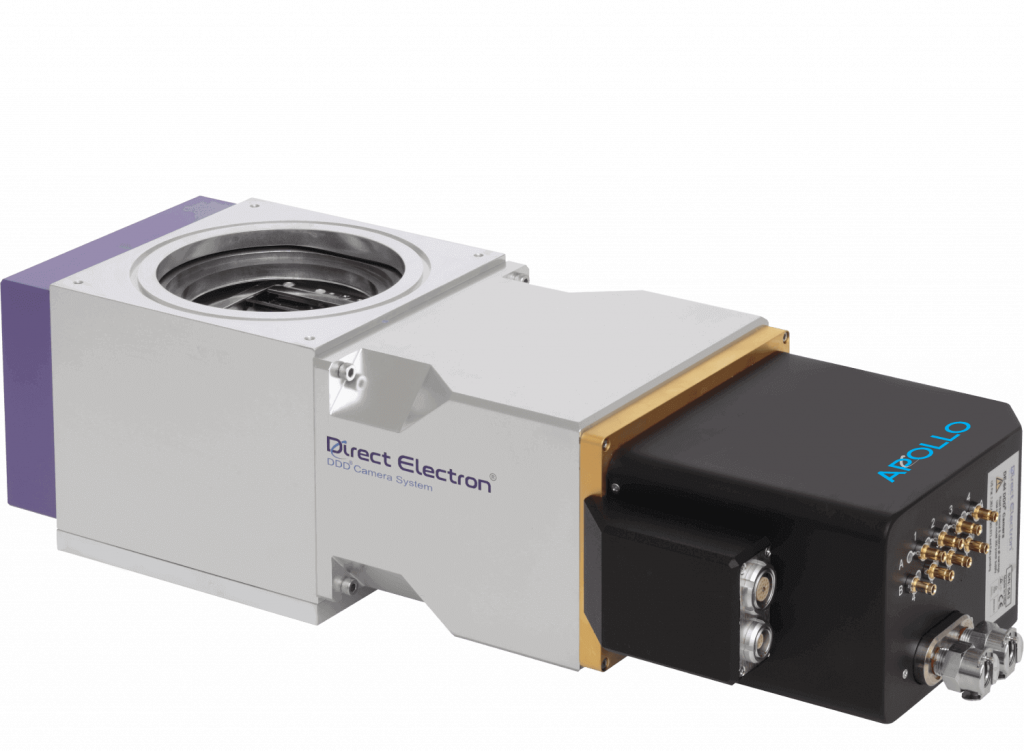
WORLD’S FIRST EVENT-BASED CAMERA FOR HIGH-THROUGHPUT CRYO-EM
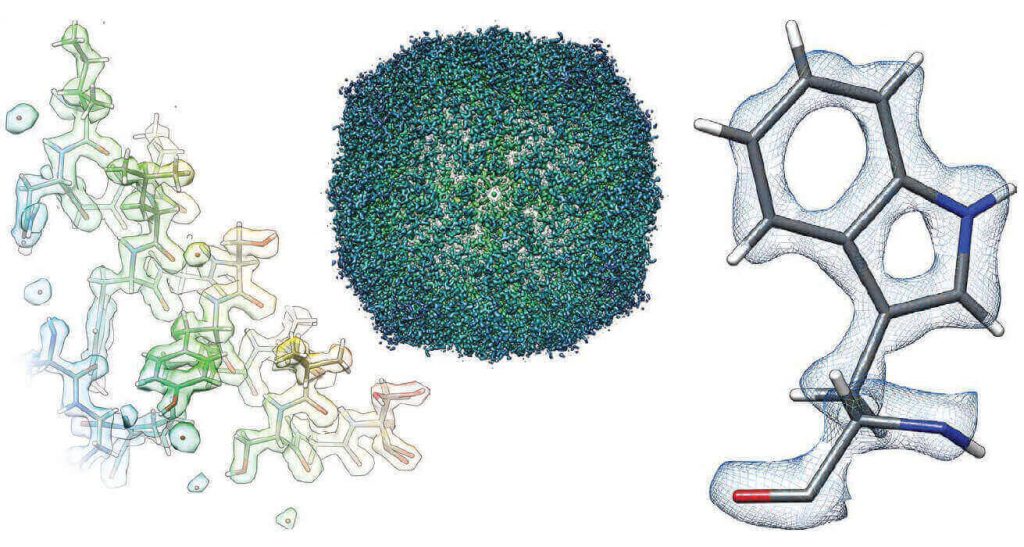
1.46 Å resolution cryo-EM structure of apoferritin (EMD-33707) from Apollo on a JEOL CRYO ARM 300 II, acquired at 12 e-/physical pixel/s (eps).
Apollo is a revolutionary event-based direct detection camera for electron cryo-microscopy (cryo-EM). Based on a novel, next generation sensor and camera architecture that performs electron counting in hardware, Apollo is the highest throughput and highest performance direct detector for cryo-EM.
We designed this new sensor from the ground up, rethinking how electron counting is performed on direct detectors. Our lengthy experience in designing custom ultra-low noise direct detectors, together with feedback from leaders in the cryo-EM community, were instrumental in guiding this ambitious project.
Rather than the brute force software-based approach implemented in existing counting cameras, Apollo performs electron counting by identifying electron detection events on the sensor, centroiding each event in FPGA hardware, and generating super-resolution (8192 x 8192) dose fractionated counted movies to be used for motion correction and other downstream cryo-EM image processing. The internal counting rate is 2560 fps, dramatically faster than previous generation cryo-EM cameras.
Apollo’s new approach of ultra-fast on-chip electron counting delivers a dramatic improvement in quality and speed, enabling counting with up to 10x higher dose rates, and thus a 10x shorter exposure time for single-particle movies than previous-generation direct detectors. It also moves Micro-ED and cryo-tomography from needing to use linear/integrating mode and finite steps, to continuous rotation, counting mode techniques. This dramatically reduces acquisition time and increases image contrast/signal-to-noise ratio.
Combining Apollo’s speed with its excellent signal-to-noise performance, Apollo can operate over an extremely wide range of exposure rates. This introduces a paradigm shift for cryo-EM. Until now, cryo-EM experiments have been dictated by the camera, forcing users to set their imaging conditions based on the tight restrictions imposed by the camera (i.e., a specific electrons/pixel/frame value). Apollo changes that. It just works… regardless of exposure rate. For the first time, cryo-EM experiments can be set up based on the optimal conditions for their TEM column, their specimen, or their method.
The resulting advances in both imaging conditions and data throughput promise to profoundly increase the productivity of cryo-EM facilities and accelerate solutions in structural biology, drug discovery, and protein analysis.
The result is extraordinary: An elegant electron counting camera that not only delivers incredible performance, but does so at a reduced total system cost.
In an article in Microscopy and Analysis magazine, our applications team describe event-based detection, and why it is so beneficial for electron counting.
In a publication in Journal of Structural Biology: X, researchers at Florida State University demonstrate that Apollo significantly outperforms other direct detectors for Cryo-EM.
The Apollo camera from Direct Electron has been shown to outperform competing cameras on the same microscope, generating significantly higher resolution reconstructions using fewer particles [Peng et al. J. Struct Bio X, 2023]. Apollo’s event-based counting technology also makes it a more budget-friendly option than other direct detectors for Cryo-EM.
With its high sensitivity, 8192 x 8192 pixel image output, and an image to disk rate of 60 images per second, the Apollo detector from Direct Electron offers the ability to rapidly acquire high-resolution tilt-series from a specimen at low dose rates [Spilman et al. Microscopy Today, 2025].
The Apollo camera from Direct Electron allows for the imaging of complex diffraction patterns with high accuracy. With the fastest electron counting speed of any large area direct detector [Spilman et al. Microscopy Today, 2025], Apollo has enabled MicroED reconstructions of specimens with structures resolved down to an unprecedented 0.5 Å [DOI: 10.51093/xrd-00140].
The true speed of an electron counting camera is determined by the rate at which it can accurately count electrons. With its event-based counting technology, Apollo is able to count electrons at nearly twice the rate of the closest competitor for any given coincidence loss level, making Apollo the fastest camera for Cryo-EM [Levin et al. Microscopy and Analysis, 2023].
If you have further questions about our products, head to our FAQ page, or contact us to learn more.
Apollo is ready to order now.
Looking for something else? We offer a full range of products for electron microscopy:
Celeritas | DE Cameras | LV-16 | SEMCam | DE Freescan | Software
1.46 Å resolution cryo-EM structure of apoferritin (EMD-33707) from Apollo on a JEOL CRYO ARM 300 II, acquired at 12 e-/physical pixel/s (eps).
Dive deeper with a carefully curated list of journal articles! Search by Application, Technique, Impact and more!