
WHY THE CAMERA SETS THE LIMIT ON AUTONOMY
Autonomous microED moves the bottleneck off the operator and onto the detector. In continuous-rotation collection, the rotation rate you can use is set by how quickly the camera delivers usable frames, and every second of rotation is another second of beam on the crystal.
That makes the camera the limiting component twice over. It decides how much of the grid can be surveyed in a session, and it decides how much of the crystal is left by the time the tilt series ends. A recent study [1] shows what changes when that component is fast.
WHAT WAS DONE?
Eremin et al. introduced Reciprocal Eyes (REyes), an open platform that runs microcrystal electron diffraction (microED) from sample insertion to solved structure without a human at the microscope. Rather than hunting for crystals in real-space images, REyes scores every point on the grid by its diffraction quality index (DQI, essentially the ratio of lattice-quality peaks to diffraction peaks), collects tilt series from the best targets, then indexes and phases them automatically.
The team installed REyes on four TEMs at two universities and ran the same workflow on Apollo and on the Thermo Fisher CETA-D. The software is detector-agnostic. What varied between systems was how fast the pipeline ran and how good the data were when it finished.
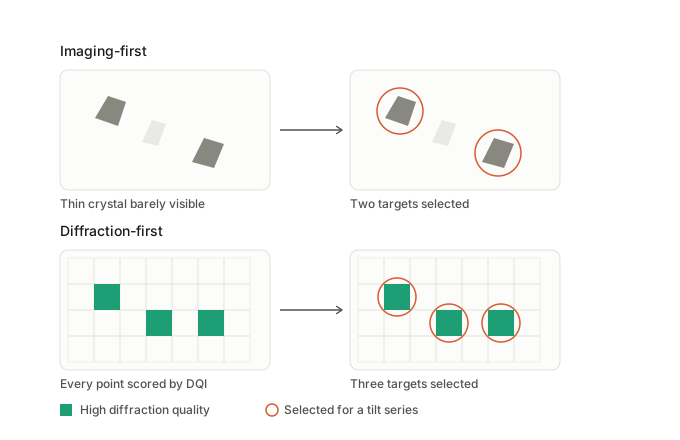
Figure 1: Imaging-first selection judges crystals by appearance and misses the thinnest ones. Diffraction-first selection scores every point on the grid by its diffraction quality index (DQI) and selects on the measurement instead, recovering a crystal too thin to image.
WHAT APOLLO’S SPEED BUYS
The clearest difference between the two cameras is the rotation rate each one supports during a tilt series.
Table 1: : Acquisition performance reported in the paper for REyes on each detector. Apollo data were collected at 298 K on a Talos F200C; CETA-D data at 80 K on a Talos Arctica.
| Parameter | DE Apollo | CETA-D |
|---|---|---|
|
Rotation rate |
1°/s |
0.12°/s |
|
Time per 100° tilt series |
~100 s |
~14 min |
|
Nine datasets, salen reference |
<30 min |
not reported |
|
Single-movie solution per benchmark sample |
<3 h |
~6 h |
On the reference salen ligand, Apollo let REyes acquire all nine datasets in under 30 minutes, averaging an I/σ of 5.3 and CC½ of 81% including the datasets that failed to index. One of the nine phased ab initio at 0.8 Å from a single movie. Run on a cryogenic Arctica with the CETA-D, the same five benchmark compounds each took ~6 h, which the authors attribute mainly to the slower rotation rate.
WHAT APOLLO’S SPEED PROTECTS
Faster collection is not only a throughput gain. A slower tilt series is a higher-dose tilt series, so the reflections measured at the end come from a crystal that has already changed. Collecting quickly is how the crystal is kept intact.
Apollo returned biotin at 97.0% completeness with an I/σ of 6.1, the AVAAGA peptide at 97.8% with an I/σ of 7.1, and grossular at 100%, all from single movies collected at room temperature. Refined R factors came out equal to or lower than the cryogenic CETA-D results on four of the five samples.
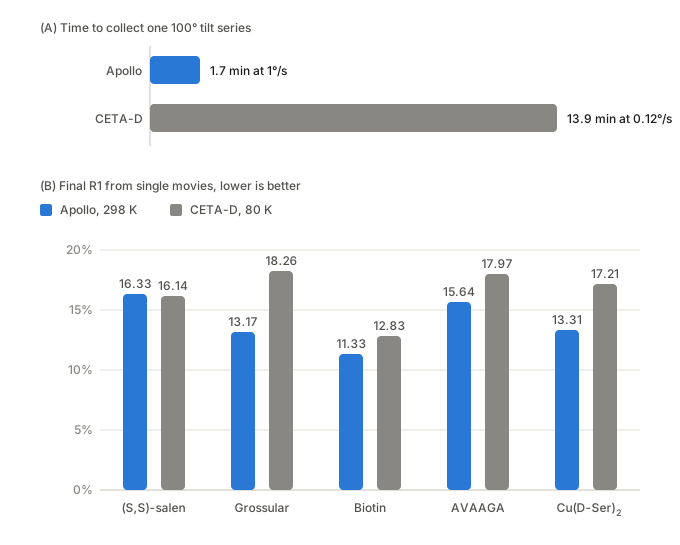
Figure 2: (A) Time to collect one 100° tilt series at the rotation rates reported for each detector. (B) Final R1 for structures solved from single REyes-acquired movies, where Apollo is equal or lower on four of five samples despite collecting at room temperature. Apollo R1 values from the paper’s Figures 3 and 4; CETA-D values from supporting information Tables S7 to S11.
The copper serinate complex shows the mechanism plainly. It is the most beam-sensitive sample in the set, and it took radiation damage during the slow cryogenic collection, capping completeness at 66.7%. The fast room-temperature Apollo data reached 77.4%, and the authors ended up refining their cryogenic model against the Apollo structure. That means cryogenic cooling did not rescue a slow acquisition. For beam-sensitive samples, collection speed is what protects data quality.
WHAT THE STUDY RAN ONLY ON APOLLO
Two results in the paper were obtained on Apollo alone, and both extend what an unattended microscope can be asked to do.
ARE THERE ANY CAVEATS?
The Apollo benchmark data were collected on a Talos F200C at room temperature and the CETA-D data on a Talos Arctica at 80 K, so the microscope and the temperature change along with the camera. Different crystals were measured on each platform. The authors note this themselves, and it is worth keeping in mind when reading Figure 2.
CONCLUSION:
Autonomous microED can run on more than one detector. What Apollo changes is whether it is practical. Collecting about eight times faster turned a full day of unattended acquisition into an afternoon, kept beam-sensitive samples intact well enough to beat cryogenic data at room temperature, and left enough session time to screen a crude extract overnight and to reach a protein structure. For researchers wanting microED to run while nobody is watching, Apollo is what makes that schedule work.
Eremin, D. B. et al. Spatially Aware Diffraction Mapping Enables Fully Autonomous MicroED. Journal of the American Chemical Society 147, 42299-42310 (2025).
REyes is freely available for academic use at github.com/theNelsonLab/pyREyes.
