DIRECT ELECTRON’S DETECTORS CAN BE AN EXCELLENT SOLUTION FOR EELS

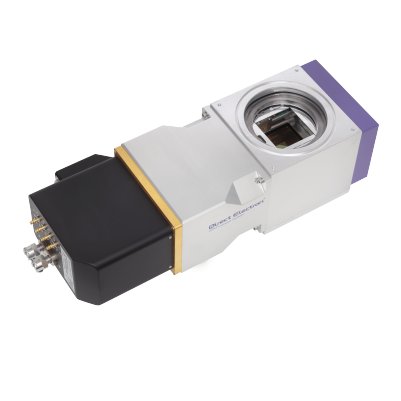
Direct Electron DE Series Camera

Electron Energy Loss Spectroscopy (EELS) is a transmission electron microscopy (TEM) technique in which electrons transmitted through a thin specimen (a few tens of nanometers thick) are dispersed by a spectrometer according to how much energy they have lost due to interactions with the specimen. EELS is a powerful technique that can allow microscopists to perform elemental analysis and also observe fine structure, and extract useful information about chemical bonding in their specimen.

The recent development of the CEOS Energy Filtering and Imaging Device (CEFID) by CEOS GmbH [1] offers microscopists a choice of cameras from different manufacturers to use to collect EELS data. In a new video posted to the Direct Electron Youtube Channel, Dr. Benjamin Bammes, our Director of Research and Development makes the case for why the DE-16 Direct Detector is ideally suited to EELS experiments.

As illustrated in the video, a typical electron energy loss spectrum may be divided into three regions; a zero-loss peak, consisting of electrons that were transmitted through the specimen without losing a significant amount of energy; a low-loss region, containing information about features such as plasmons and band gap states; and finally a core-loss region, extending out to many keV of energy loss (not all of which can be shown in the video graphic), which contains information about the electron energy levels in the atoms that make up the specimen.

Ideally, an EELS detector would be able to acquire spectra that cover a wide energy range, containing the zero-loss peak as well as low-loss and core-loss information, while maintaining a high energy resolution so that fine structure can be clearly resolved.
Direct Electron’s patent pending HDR counting technique, which was described in a recent article on 4D STEM in Microscopy and Analysis [2], can allow us to detect single electron events in areas of the spectrum where the signal is relatively weak, without losing information from more intense parts of the spectrum, such as the zero-loss peak. Combined with a pixel count of 4096 in the energy dispersive direction, HDR counting can allow the DE-16 to acquire spectra with high dynamic range over a large energy range, with high energy resolution.

For more details on why the DE-16 is well suited to EELS, check out our YouTube video!

References

[1] Kahl, et. al. Advances in Imaging and Electron Physics212, 35-70 (2019).

[2] Levin et. al. Microscopy and Analysis, 34(1), 20-22 (EU), February 2020.
Categories

What’s New

Read More

Direct Electron at IMC21 in Liverpool

Catch up with Direct Electron at IMC21 Direct Electron Applications Scientist Dr. Barnaby Levin will be presenting three contributions highlighting advances in direct detection and new approaches to data collection across several microscopy applications: Advances in MAPS Direct Detector Technology for EBSD, TKD, LEEM and PEEMMonday, August 31 | Surface Sensitive Microscopy, Analysis and Sample Manipulation | 10:35 AM–12:20 PM A Rapid Electron Counting Detector and GPU Powered Software for In Situ TEMTuesday, September 1 | Poster Session 2 | 5:30–6:30 PM Accelerating In Situ 4D STEM by Combining Custom Scan Patterns and Hardware Drift CorrectionWednesday, September 2 | Innovating Microscopy End-to-End: Hardware, Automation, and AI in Honour of Albert Crewe | 1:40–3:25 PM Direct Electron Cameras in Research at IMC21 We’re also excited to see work from researchers using Direct Electron cameras represented throughout the IMC21 scientific program. Prof. David Bhella, Professor of Structural Virology and Director of the Scottish Centre for Macromolecular Imaging at the University of Glasgow, will present “Frozen in Time: Cryo-EM Reveals Both Conserved and Novel Structural Features in a Divergent Herpesvirus Lineage,” featuring work with the Apollo direct electron detector, during the Cryo-EM session on Tuesday, September 1. Additional work from Bhella and colleagues will be presented during Wednesday’s poster session, including “Revealing the Native Architecture of RSV Replication Complexes Through In-Situ Structural Biology” and “Conformational Analysis of the Measles Virus Nucleocapsid Using Cryo-EM and Molecular Dynamics.” Researchers from the Max Planck Institute will also present several contributions featuring work with the DE-16, spanning ultrafast electron microscopy and diffraction: Steady-State Operando Imaging and Laser-Driven Megahertz Cycling of Ultrafast Charge-Density Wave Phase Transitions — Till Domröse Ultrafast Nanobeam Electron Diffraction of Structural Phase Transformations in 2D Materials — Sophie F. Schaible Stimulated Inelastic Electron Holography — Tim Dauwe Ultrafast Electron Microscopy and Free-Electron Quantum Optics — Claus Ropers, invited presentation We’re proud to see Direct Electron technology supporting such a diverse range of microscopy research and look forward to hearing the results in Liverpool. Going to IMC21? Stop by Booth 253 and say hello. We look forward to seeing you there!

Direct Electron at M&M 2026!

Direct Electron is excited to attend Microscopy & Microanalysis 2026, the premier annual meeting for the microscopy community, taking place August 2–6, 2026 in Milwaukee, Wisconsin. We invite attendees to stop by Booth 1130 to explore our latest direct detection technologies and discover the right detector for their application. Visit us to learn more about our flagship Apollo and Celeritas direct detection cameras, as well as our newest detector solutions designed for cryo-EM, SEM, 4D-STEM, EBSD, TKD, LEEM, and PEEM applications. Looking to start your mornings with fellow attendees? Join the conference’s informal morning run/walk, organized by Direct Electron Sales Director Bob Monteverde and MSA member Janet Gbur. The group meets Monday through Thursday at 6:00 AM outside the Baird Center main entrance (400 W. Wisconsin Avenue) for runs of 2–4 miles or a 1-mile walk. We look forward to seeing you in Milwaukee and discussing how Direct Electron can help advance your research.

Questions?