First publication from the Celeritas XS detector

Prof. Paul Voyles and researchers at the University of Wisconsin Madison in the USA have published the first results acquired using a Celeritas XS detector in Ultramicroscopy.

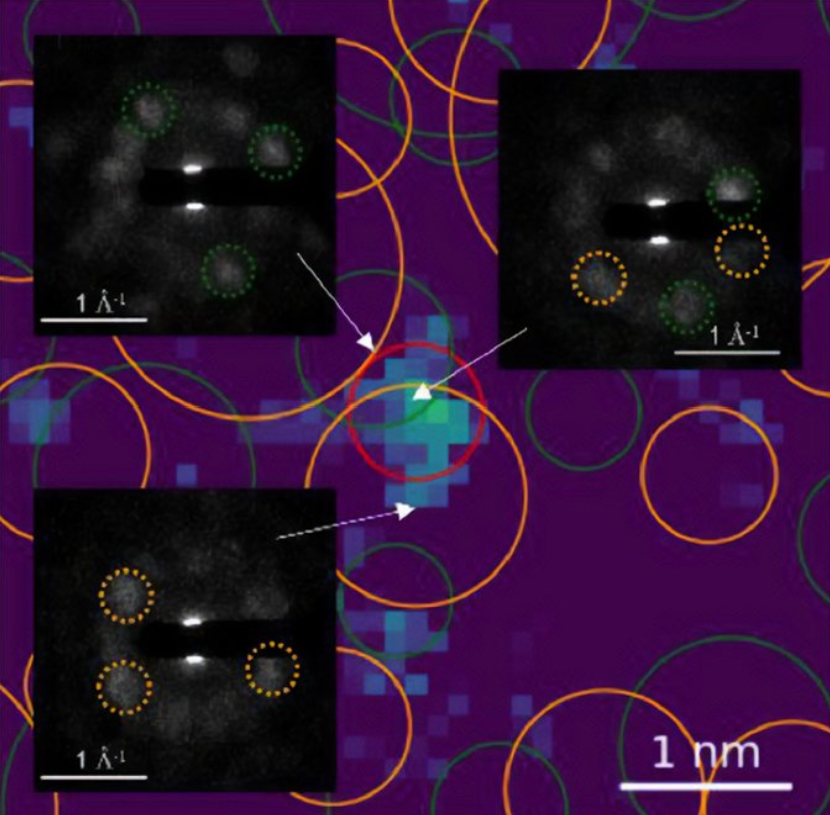
They took advantage of the detector’s rapid acquisition speed and sensitivity to use 4D STEM to map large areas of metallic glasses at nanometer-scale spatial resolution based on local rotational symmetry in diffraction patterns.

The paper can be found at the link below:

https://doi.org/10.1016/j.ultramic.2022.113612

Categories

What’s New

Read More

Call for Abstracts: Join Direct Electron at the 2027 MRS Spring Meeting in Seattle

Abstract submissions are now open for the 2027 MRS Spring Meeting & Exhibit, including Symposium CH02: Advanced Electron Imaging, Diffraction and Spectroscopy Applied to Structurally Complex Materials. Direct Electron Applications Scientist Dr. Barnaby Levin is co-organizing Symposium CH02 at the 2027 MRS Spring Meeting & Exhibit, taking place April 5–9, 2027, in Seattle, Washington. The symposium will bring together researchers using advanced electron imaging, diffraction, and spectroscopy to investigate the relationships between structure and properties in complex materials. The program will span applications in electronic technologies, biomedicine, quantum materials, and other areas where understanding material structure across multiple length scales is critical. Particular emphasis will be placed on materials and structures that present challenging characterization problems, including disordered and amorphous materials, biomaterials, defective and strained crystals, grain boundaries and heterostructures, electric and magnetic structures, and materials with complex three-dimensional morphology. The symposium will also explore dynamic structural transformations, including changes driven by temperature, irradiation, electrochemical cycling, mechanical stress, and liquid or gas environments. Symposium Topics Topics of interest include: Disordered and amorphous materials Defective and strained materials Biomaterials Electric and magnetic structures in materials Characterization of 3D material structure Structural transformations with temperature change Structural transformations under irradiation Structural transformations in liquid and gas environments Grain boundaries and heterostructures Quantum materials Symposium Organizers Dr. Levin is organizing the symposium alongside Quentin Ramasse, SuperSTEM; Kayla Nguyen, University of Oregon; and Raymond Unocic, North Carolina State University. Share Your Research at MRS 2027 Researchers working with advanced electron microscopy techniques for structurally complex materials are encouraged to submit their work and join the discussion in Seattle. Abstract submissions open September 16, 2026. 2027 MRS Spring Meeting & ExhibitApril 5–9, 2027Seattle, Washington

Direct Electron at IMC21 in Liverpool

Catch up with Direct Electron at IMC21 Direct Electron Applications Scientist Dr. Barnaby Levin will be presenting three contributions highlighting advances in direct detection and new approaches to data collection across several microscopy applications: Advances in MAPS Direct Detector Technology for EBSD, TKD, LEEM and PEEMMonday, August 31 | Surface Sensitive Microscopy, Analysis and Sample Manipulation | 10:35 AM–12:20 PM A Rapid Electron Counting Detector and GPU Powered Software for In Situ TEMTuesday, September 1 | Poster Session 2 | 5:30–6:30 PM Accelerating In Situ 4D STEM by Combining Custom Scan Patterns and Hardware Drift CorrectionWednesday, September 2 | Innovating Microscopy End-to-End: Hardware, Automation, and AI in Honour of Albert Crewe | 1:40–3:25 PM Direct Electron Cameras in Research at IMC21 We’re also excited to see work from researchers using Direct Electron cameras represented throughout the IMC21 scientific program. Prof. David Bhella, Professor of Structural Virology and Director of the Scottish Centre for Macromolecular Imaging at the University of Glasgow, will present “Frozen in Time: Cryo-EM Reveals Both Conserved and Novel Structural Features in a Divergent Herpesvirus Lineage,” featuring work with the Apollo direct electron detector, during the Cryo-EM session on Tuesday, September 1. Additional work from Bhella and colleagues will be presented during Wednesday’s poster session, including “Revealing the Native Architecture of RSV Replication Complexes Through In-Situ Structural Biology” and “Conformational Analysis of the Measles Virus Nucleocapsid Using Cryo-EM and Molecular Dynamics.” Researchers from the Max Planck Institute will also present several contributions featuring work with the DE-16, spanning ultrafast electron microscopy and diffraction: Steady-State Operando Imaging and Laser-Driven Megahertz Cycling of Ultrafast Charge-Density Wave Phase Transitions — Till Domröse Ultrafast Nanobeam Electron Diffraction of Structural Phase Transformations in 2D Materials — Sophie F. Schaible Stimulated Inelastic Electron Holography — Tim Dauwe Ultrafast Electron Microscopy and Free-Electron Quantum Optics — Claus Ropers, invited presentation We’re proud to see Direct Electron technology supporting such a diverse range of microscopy research and look forward to hearing the results in Liverpool. Going to IMC21? Stop by Booth 253 and say hello. We look forward to seeing you there!

Questions?