FLORENCE AND THE GALILEO MUSEUM

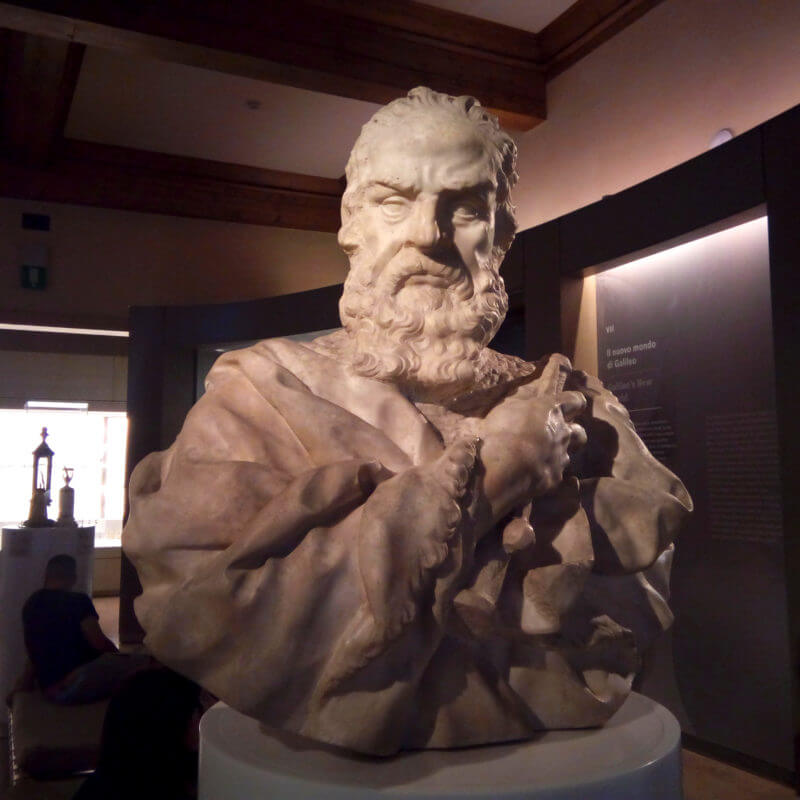
Statue of Socrates

OUR MATERIALS APPLICATIONS SCIENTIST, BARNABY LEVIN, DESCRIBES A HIGHLIGHT FROM HIS TRIP TO ITALY IN JANUARY

In January 2020, I had the privilege of representing Direct Electron at the Gordon Research Conference for Liquid Phase Electron Microscopy, which was held at the Renaissance Tuscany Il Ciocco in Italy. After the conference, I spent a week travelling to visit some of our customers in Germany and the UK.
In between the conference and my customer visits, I had a free weekend to do some sightseeing, and I chose to spend that weekend in the historic Italian city of Florence.

In addition to visiting some of the city’s most famous attractions (The Duomo and Brunelleschi’s famous dome, the Palazzo Vecchio, and the incredible collection of Renaissance and Classical art at the Uffizi Gallery), I made time to visit a slightly less well known museum, but one that offers visitors some fascinating insights into the history of science: The Museo Galileo.
The museum houses a large collection of historic scientific instruments used by Florentine scientists from Galileo Galilei himself, to 19th century scientists such as Giovanni Battista Amici.  The museum also explains how these Florentine scientists made important contributions to a wide range of scientific fields, from Astronomy to Medicine. Of particular interest from an Electron Microscopist’s point of view was the Museo Galileo’s collection of historic vacuum instruments. According to the description accompanying this collection, the scientists of Florence’s Accademia del Cimento (Academy of Experiments) performed some of the earliest experiments to investigate whether it was possible to create a vacuum, demolishing the traditional belief that vacuums couldn’t exist. Today, the ability to create and maintain a vacuum is, of course, fundamental to many technologies, including the Electron Microscope.

In future, I hope to be able to visit Italy again, and learn more about Italy’s contributions to science and culture.
Categories

What’s New

Read More

Direct Electron at IMC21 in Liverpool

Catch up with Direct Electron at IMC21 Direct Electron Applications Scientist Dr. Barnaby Levin will be presenting three contributions highlighting advances in direct detection and new approaches to data collection across several microscopy applications: Advances in MAPS Direct Detector Technology for EBSD, TKD, LEEM and PEEMMonday, August 31 | Surface Sensitive Microscopy, Analysis and Sample Manipulation | 10:35 AM–12:20 PM A Rapid Electron Counting Detector and GPU Powered Software for In Situ TEMTuesday, September 1 | Poster Session 2 | 5:30–6:30 PM Accelerating In Situ 4D STEM by Combining Custom Scan Patterns and Hardware Drift CorrectionWednesday, September 2 | Innovating Microscopy End-to-End: Hardware, Automation, and AI in Honour of Albert Crewe | 1:40–3:25 PM Direct Electron Cameras in Research at IMC21 We’re also excited to see work from researchers using Direct Electron cameras represented throughout the IMC21 scientific program. Prof. David Bhella, Professor of Structural Virology and Director of the Scottish Centre for Macromolecular Imaging at the University of Glasgow, will present “Frozen in Time: Cryo-EM Reveals Both Conserved and Novel Structural Features in a Divergent Herpesvirus Lineage,” featuring work with the Apollo direct electron detector, during the Cryo-EM session on Tuesday, September 1. Additional work from Bhella and colleagues will be presented during Wednesday’s poster session, including “Revealing the Native Architecture of RSV Replication Complexes Through In-Situ Structural Biology” and “Conformational Analysis of the Measles Virus Nucleocapsid Using Cryo-EM and Molecular Dynamics.” Researchers from the Max Planck Institute will also present several contributions featuring work with the DE-16, spanning ultrafast electron microscopy and diffraction: Steady-State Operando Imaging and Laser-Driven Megahertz Cycling of Ultrafast Charge-Density Wave Phase Transitions — Till Domröse Ultrafast Nanobeam Electron Diffraction of Structural Phase Transformations in 2D Materials — Sophie F. Schaible Stimulated Inelastic Electron Holography — Tim Dauwe Ultrafast Electron Microscopy and Free-Electron Quantum Optics — Claus Ropers, invited presentation We’re proud to see Direct Electron technology supporting such a diverse range of microscopy research and look forward to hearing the results in Liverpool. Going to IMC21? Stop by Booth 253 and say hello. We look forward to seeing you there!

Direct Electron at M&M 2026!

Direct Electron is excited to attend Microscopy & Microanalysis 2026, the premier annual meeting for the microscopy community, taking place August 2–6, 2026 in Milwaukee, Wisconsin. We invite attendees to stop by Booth 1130 to explore our latest direct detection technologies and discover the right detector for their application. Visit us to learn more about our flagship Apollo and Celeritas direct detection cameras, as well as our newest detector solutions designed for cryo-EM, SEM, 4D-STEM, EBSD, TKD, LEEM, and PEEM applications. Looking to start your mornings with fellow attendees? Join the conference’s informal morning run/walk, organized by Direct Electron Sales Director Bob Monteverde and MSA member Janet Gbur. The group meets Monday through Thursday at 6:00 AM outside the Baird Center main entrance (400 W. Wisconsin Avenue) for runs of 2–4 miles or a 1-mile walk. We look forward to seeing you in Milwaukee and discussing how Direct Electron can help advance your research.

Questions?