DIRECT ELECTRON INTRODUCES APOLLO
THE WORLD’S FIRST EVENT-BASED CAMERA FOR HIGH THROUGHPUT CRYO-EM

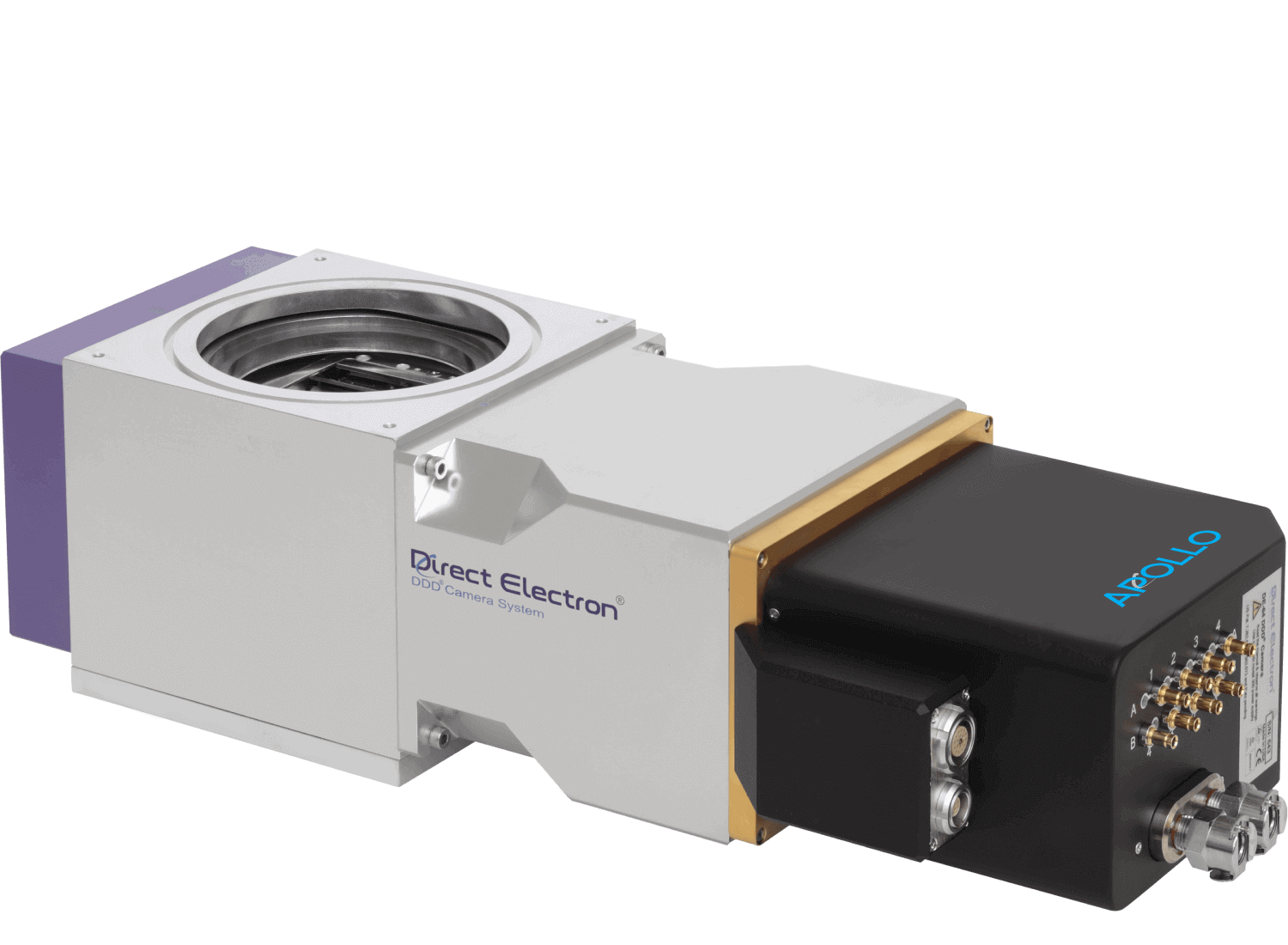
San Diego, CA (USA), March 1, 2021 – Direct Electron, a leading producer of next-generation direct detection cameras for transmission electron microscopes (TEM), today announces Apollo, a revolutionary new event-based direct detection camera for electron cryo-microscopy (cryo-EM). Based on a next generation sensor and camera architecture delivering electron counting in hardware, Apollo is the highest throughput direct detector for cryo-EM.
Apollo represents a completely new approach to electron counting. Rather than the brute force software-based approach implemented in existing counting cameras, Apollo performs electron counting by identifying electron detection events on the sensor, processing each event in edge computing FPGA hardware, and generating super-resolution (67 megapixel) frames at extremely high-speed that are optimized for downstream cryo-EM image processing before they leave the camera.
Apollo’s new approach of ultra-fast on-chip electron counting delivers a dramatic improvement in quality and speed, enabling counting with up to 10x higher beam brightness, and thus a 10x shorter exposure time than previous generation direct detectors.
Combining Apollo’s speed with its excellent signal-to-noise performance, Apollo can operate over an extremely wide range of dose-rates. This introduces a paradigm-shift for cryo-EM by enabling users, for the first time, to setup their experiments based on the optimal conditions for their TEM column, their specimen, or their method. The resulting advances in both imaging conditions and data throughput promise to profoundly increase the productivity of cryo-EM facilities and accelerate solutions in structural biology, drug discovery, and protein analysis.
Dr. Benjamin Bammes, Director of Research and Development at Direct Electron, said, “After more than eight years of active research and development, we are excited to be announcing Apollo. We designed this new sensor from the ground up, rethinking how electron counting is performed on direct detectors. Our lengthy experience in designing custom ultra-low noise direct detectors, together with feedback from leaders in the cryo-EM community, were instrumental in guiding this ambitious project. The result is extraordinary, an elegant electron counting camera that not only delivers incredible performance, but does so at a reduced total system cost.”
Dr. Robert Glaeser, Professor Emeritus of Biochemistry, Biophysics and Structural Biology at University of California, Berkeley, said, “I am thrilled to hear about this new camera. Performing electron counting in hardware represents a significant advance in CMOS camera technology. The resulting linearity and low noise of the Apollo camera, along with its larger pixel size, is a very smart, well-optimized design. I expect this technology to have a major impact on future applications of cryo-EM.”
Apollo is expected to drive higher throughput and overall productivity for high-resolution single particle (SPA) cryo-EM, as well as enable future applications such as high-throughput continuous-rotation cellular tomography.
Apollo is integrated in SerialEM and other cryo-EM automation software packages and is compatible with all popular cryo-EM columns.
Apollo is available to order immediately, with delivery for orders placed now expected within the second quarter (Q2) of this year.